
Tornado Warning False Alarm Rate Sits at 75% and Has Not Improved Despite Decades of Technology Advances, Raising Dangerous Warning Fatigue Concerns Across Tornado-Prone States
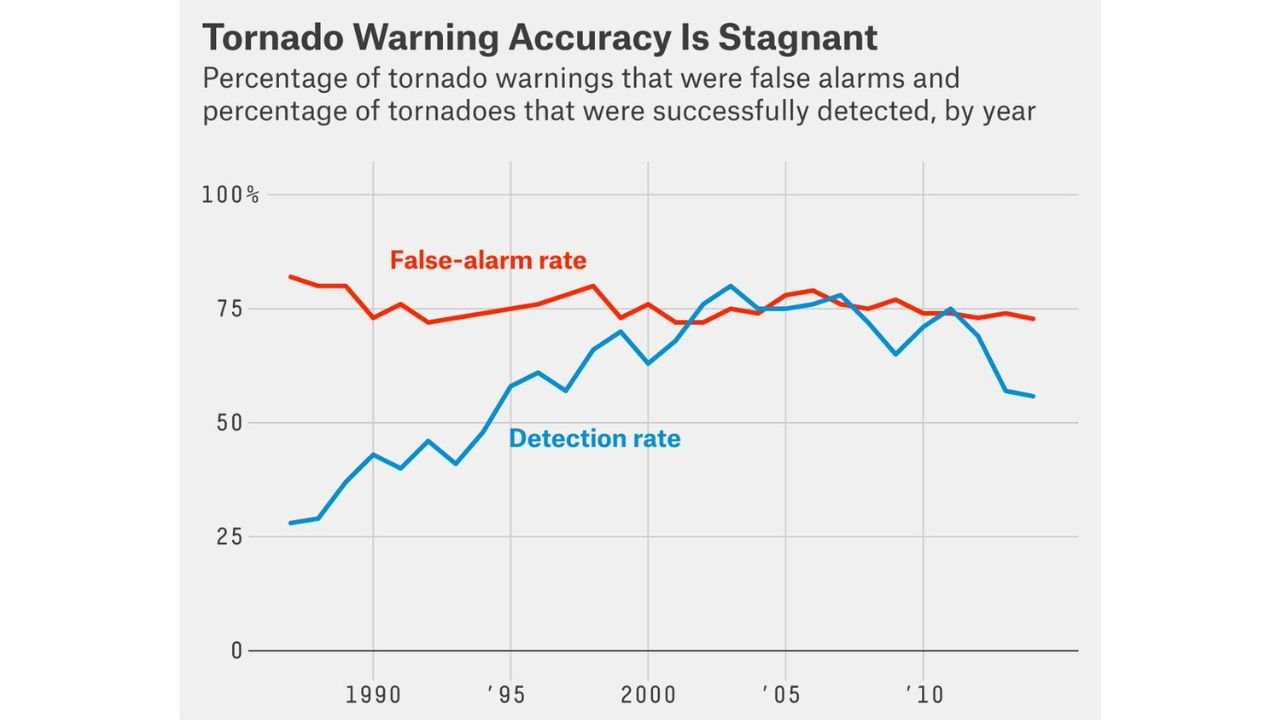
JACKSON, Mississippi — A striking data point presented at the Mississippi State Severe Storms Symposium is reigniting a critical debate inside the weather community and among the public it serves. The false alarm rate for tornado warnings sits at approximately 75% and has shown virtually no improvement despite decades of advancing radar technology, better computer models, and improved storm understanding. Three out of every four tornado warnings issued do not result in a confirmed tornado. The consequence playing out in real time was visible last month when false alarm frustration drove how do I disable weather alerts on my phone to trend on social media during an active severe weather outbreak, raising an alarming question: at what point does over-warning create a public that ignores the warnings that matter most?
What the Data Actually Shows
The FiveThirtyEight chart using National Weather Service data tells the story across three decades in two lines that should concern anyone who follows severe weather.
| Metric | 1986 Approximate | Current Approximate | Change Over 30 Years |
|---|---|---|---|
| False alarm rate | 80 to 85% | 75% | Modest improvement, essentially stagnant |
| Detection rate | 25 to 30% | 55 to 60% | Significant improvement |
The detection rate improvement is genuinely meaningful. Going from detecting roughly 1 in 4 tornadoes in the mid-1980s to detecting more than 1 in 2 today represents real progress in warning people before confirmed tornadoes touch down. The installation of the national Doppler radar network in the 1990s drove most of that detection improvement, which explains the steep blue line climb through the 1990s on the chart.
But the false alarm rate tells a fundamentally different story. Despite the same technology revolution that dramatically improved detection, the false alarm rate barely moved. It was near 80% in the late 1980s and it sits near 75% today. Decades of advancement produced essentially no improvement in the rate at which warnings go out for tornadoes that never materialize.
Why the False Alarm Rate Will Not Come Down Easily
| Reason | Explanation |
|---|---|
| Radar detects rotation, not tornadoes | Doppler radar measures rotating air within a storm, which can exist without a tornado ever touching the ground. Warning on rotation means warning on potential, not confirmed reality. |
| Better detection requires earlier warnings | The earlier a warning is issued before a tornado forms, the more time people have to shelter. But earlier warnings also increase false alarms because not every rotating storm produces a tornado. |
| Warning philosophy favors caution | The meteorological community has long operated under the principle that missing a tornado is worse than issuing a false alarm. That philosophy is mathematically embedded in the 75% rate. |
| Technology detects more rotation | Better radar reveals more rotating storms that would have gone undetected before, many of which never produce tornadoes, which keeps the false alarm denominator high. |
| Geography and terrain | Some regions produce more warning-worthy rotation signatures that dissipate before touchdown due to local atmospheric factors that even modern technology cannot fully predict. |
Warning Fatigue — The Hidden Death Toll Problem
The social media trending of phone alert disabling during an active outbreak is not an isolated complaint. It is a documented behavioral phenomenon with life-threatening consequences.
| Warning Fatigue Stage | What Happens |
|---|---|
| Stage 1 — Annoyance | Repeated false alarms create frustration with alerts that do not result in actual tornadoes |
| Stage 2 — Dismissal | People begin treating warnings as background noise rather than immediate action triggers |
| Stage 3 — Disabling | Active steps taken to suppress or disable weather alerts on personal devices |
| Stage 4 — Delayed response | Even when warnings are received, people wait to see if the threat materializes before seeking shelter |
| Stage 5 — Fatal outcome | Delayed sheltering during an actual tornado results in deaths that would not have occurred with immediate response |
The boy who cried wolf problem in tornado warning is not theoretical. Research on warning response consistently shows that communities with higher false alarm exposure demonstrate slower shelter-seeking behavior when actual tornadoes threaten. A 75% false alarm rate means the last 3 warnings before a real tornado were all false, conditioning residents to hesitate at exactly the wrong moment.
The Competing Dangers on Each Side of the Problem
This is genuinely one of the hardest problems in applied meteorology because both errors carry lethal consequences.
| Error Type | What It Means | Consequence |
|---|---|---|
| False alarm — warning with no tornado | Warn and no tornado occurs | Warning fatigue, public distrust, people disable alerts, delayed response to real events |
| Miss — tornado with no warning | Tornado occurs without a warning being issued | People caught completely off guard with zero lead time, higher death toll from that specific event |
The current system is calibrated heavily toward avoiding misses because a miss with a violent tornado produces immediate, visible, and devastating deaths. False alarms produce deaths too, but they are statistical, diffuse, and invisible — they show up as slightly slower shelter response in future events rather than as a single headline-generating tragedy.
What Needs to Change and Why It Is So Difficult
| Proposed Solution | Challenge |
|---|---|
| Probability-based warnings | Replacing binary warn/no-warn with probability language is more accurate but harder for the public to act on quickly |
| Tornado confirmed warnings | Only warning after ground truth confirmation eliminates false alarms but removes lead time entirely |
| Tiered warning system | Separating rotating storm alerts from confirmed tornado warnings could reduce fatigue while preserving confirmed tornado urgency |
| Public education campaigns | Teaching communities why false alarms happen and why response still matters has shown limited effectiveness at scale |
| Improved storm-scale modeling | Better prediction of which rotating storms will produce touchdowns requires computational advances not yet available operationally |
The detection rate improvement from 25% to 55 to 60% proves that technology can move the needle on warning accuracy when the right tools are deployed. The fact that the false alarm rate has not moved in the same period suggests the false alarm problem is not primarily a technology problem. It is a fundamental challenge of warning on processes that are inherently uncertain until the moment they either produce a tornado or dissipate.
What This Means for Residents Across Tornado-Prone States
- Do not disable weather alerts. The frustration behind the trending search is completely understandable, but the one warning in four that is real represents a tornado that can kill without any other warning. Disabling alerts removes the only lead time available when a real one arrives.
- The 75% false alarm rate means the system is working as designed, not broken. The tradeoff between false alarms and missed events is a deliberate calibration, not an oversight. Every false alarm represents a rotating storm that was real and dangerous, even if it did not produce a confirmed touchdown.
- Response behavior matters more than the warning itself. The most dangerous outcome of warning fatigue is not annoyance. It is the moment a person decides to check social media before seeking shelter because the last three warnings turned out to be nothing.
- The debate is legitimate and important. Weather professionals debating how to restructure the warning system to reduce fatigue without increasing missed events are working on one of the most consequential public safety problems in meteorology. It deserves serious public engagement rather than dismissal.
WaldronNews.com will continue tracking developments in tornado warning technology and public safety research and provide updates as the meteorological community works toward solutions to the warning fatigue problem.