
Alaska Cold Wave Sets New Modern Benchmark as Fairbanks Logs 21st Day at or Below -40°F and Tanana Drops to -58°F
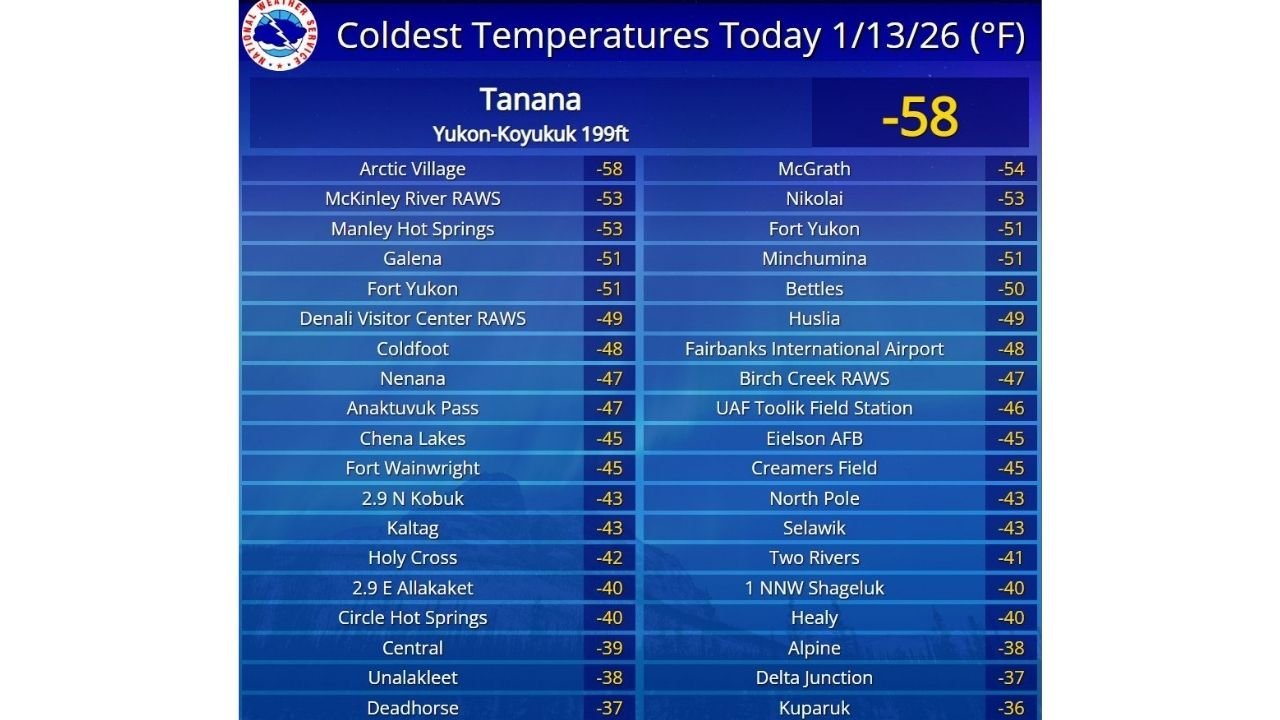
ALASKA – Northern Alaska logged another round of dangerous, deep Arctic cold Tuesday, with new observations showing temperatures plunging well below -40°F across multiple interior communities. The update also notes a major seasonal milestone at Fairbanks International Airport: Tuesday marked the 21st day this season at or below -40°F, the highest number of -40°F days in Fairbanks in 55 years, dating back to the 1970–71 season.
The coldest value highlighted in the data came from Tanana (Yukon-Koyukuk, 199 ft), where the temperature bottomed out at -58°F.
Coldest readings reported across Northern Alaska
The observation list from Jan. 13 shows a wide cluster of extreme lows, including multiple locations in the -40s to -50s, a range where frostbite can occur quickly on exposed skin and where even routine tasks become hazardous.
Here are some of the standout lows from the data:
- Tanana: -58°F
- Arctic Village: -58°F
- McGrath: -54°F
- McKinley River RAWS: -53°F
- Manley Hot Springs: -53°F
- Nikolai: -53°F
- Galena: -51°F
- Fort Yukon: -51°F
- Minchumina: -51°F
- Bettles: -50°F
- Denali Visitor Center RAWS: -49°F
- Huslia: -49°F
- Coldfoot: -48°F
- Fairbanks International Airport: -48°F
- Nenana: -47°F
- Birch Creek RAWS: -47°F
- Anaktuvuk Pass: -47°F
- UAF Toolik Field Station: -46°F
- Chena Lakes: -45°F
- Eielson AFB: -45°F
- Creamers Field: -45°F
- Fort Wainwright: -45°F
- North Pole: -43°F
- Kaltag: -43°F
- Selawik: -43°F
- Holy Cross: -42°F
- Two Rivers: -41°F
- Healy: -40°F
- Circle Hot Springs: -40°F
- 1 NNW Shageluk: -40°F
- Central: -39°F
- Alpine: -38°F
- Unalakleet: -38°F
- Delta Junction: -37°F
- Deadhorse: -37°F
- Kuparuk: -36°F
Fairbanks milestone: a rare stretch of -40°F days
While Alaska frequently sees intense cold in midwinter, the persistence of the cold is what stands out here. Reaching 21 days at or below -40°F at Fairbanks International Airport this season puts the winter into a category that’s not common in the modern record for the area, according to the note included with the data.
That kind of sustained cold can increase day-to-day impacts beyond the obvious health risk: higher energy demand, mechanical failures, frozen plumbing, vehicle issues, and challenges for outdoor work and travel logistics.
What this level of cold means for daily life
When temperatures settle into the -40°F to -60°F range, the environment changes quickly:
- Frostbite risk rises sharply, especially if there’s any breeze.
- Vehicle reliability drops without proper winterization (battery strain, fluid thickening, fuel-line issues).
- Plumbing and heating systems are under more stress, especially in exposed or poorly insulated areas.
- Outdoor travel becomes more dangerous, because small problems (a breakdown, a delay, a wrong turn) escalate fast.
Even when skies are clear, the cold alone can create emergency conditions.
Bottom line
Northern Alaska saw some of its harshest cold of the season on Jan. 13, led by -58°F at Tanana, with widespread readings in the -40s and -50s across the Interior and nearby regions. In Fairbanks, the cold has been unusually persistent, with 21 days at or below -40°F, the highest such count in 55 years dating to 1970–71.
Where in Alaska are you tracking this cold — Fairbanks, the Yukon-Koyukuk region, or farther north? Share your town and your lowest reading, and keep following the Waldron website for the next Arctic update.