
Arizona Faces Earliest 100° Day in History as Phoenix Hits Triple Digits with 6% Humidity, Shattering 1988 March Record Weeks Ahead of Schedule
PHOENIX, ARIZONA — The Valley of the Sun has just crossed a historic threshold. Phoenix officially reached 100°F at Sky Harbor International Airport, marking the earliest 100-degree day ever recorded in city history — breaking a record that had stood since March 26, 1988.
What makes this milestone even more remarkable is the atmospheric dryness accompanying the heat. At the time Phoenix hit 100°F, relative humidity was just 6 percent, reinforcing the classic desert phrase: “It’s a dry heat.”
Record Broken More Than a Week Early
Prior to today, the earliest 100-degree reading in Phoenix history occurred on March 26, 1988.
The city also came close during:
- March 16–17, 2007 (99°F)
Now, Phoenix has reached triple digits in mid-March — eight days earlier than the previous benchmark.
Breaking a long-standing seasonal threshold by more than a week is a rare climate event, particularly for a temperature as psychologically and meteorologically significant as 100°F.
Current Conditions at Sky Harbor
At the time of the historic reading, conditions at Phoenix Sky Harbor (KPHX) showed:
- Temperature: 100°F (38°C)
- Humidity: 6%
- Dewpoint: 26°F
- Wind: West at 8 mph
- Heat Index: 94°F
The extremely low humidity meant that, despite the triple-digit air temperature, the heat index remained slightly below the actual temperature.
This dry air mass is typical of strong spring desert ridging events, where sinking air suppresses moisture and maximizes heating efficiency.
Widespread Southwest Heat
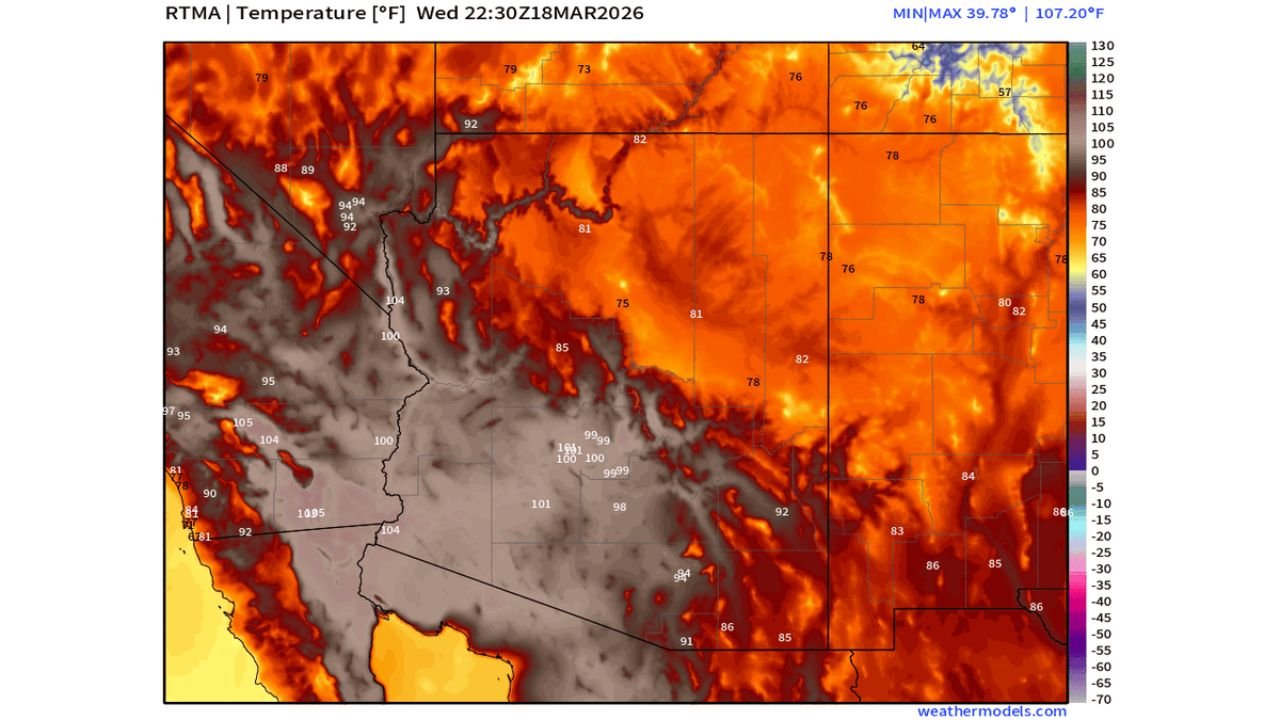
Temperature analysis across the region shows that Phoenix was not alone in experiencing extreme heat.
Nearby readings included:
- Yuma: near 100°F
- Lake Havasu City: upper 90s
- Southern Nevada: mid to upper 90s
- Southeastern California: near or above 100°F
The broader Southwest has been under the influence of a powerful upper-level ridge, compressing and warming air across Arizona, California and Nevada.
Why This Matters
March is typically a transitional month in Phoenix, with average highs in the upper 70s to low 80s. Triple-digit heat is normally reserved for late April or May.
Reaching 100°F this early:
- Highlights the intensity of this heat event
- Establishes a new seasonal benchmark
- Reinforces the unusual nature of this March heatwave
For residents, it also serves as an early reminder of summer-like conditions — weeks ahead of schedule.
A Preview of What’s Ahead?
While one early 100-degree day does not define an entire warm season, it does underscore how anomalous this spring pattern has been across the Southwest.
With humidity at just 6 percent, skies clear and sunshine abundant, the desert atmosphere proved highly efficient at producing record heat.
Phoenix has officially rewritten its climate calendar — and the Valley is already feeling like June in March.
Stay with WaldronNews.com for continued coverage of historic weather events unfolding across the western United States.