
Baltimore and Washington Remain in Severe Drought Despite Winter Snow, With Rainfall Nearly 10 Inches Below Normal Since Fall
WASHINGTON, D.C. – After weeks of snow and ice, many residents are asking the same question: how can we still be in severe drought? The latest data from the U.S. Drought Monitor and seasonal precipitation records show that while winter weather has added moisture, it has not come close to erasing the long-term deficit that has built up over months.
Drought Monitor Still Shows Severe Conditions
The February 10, 2026 U.S. Drought Monitor for the Baltimore/Washington Weather Forecast Office region indicates widespread D2 – Severe Drought across much of central Maryland, northern Virginia, and the Washington metro area. Only small pockets near the Chesapeake Bay show slightly lower categories.
This classification reflects long-term moisture shortages, not just recent storms. Even with snow on the ground, drought status is based on cumulative rainfall deficits, soil moisture, streamflow, and groundwater conditions.
Why 6–9 Inches of Snow Didn’t Fix the Problem
The January 25 snowstorm delivered 6 to 9 inches of snow across parts of the region. However, snow does not equal rainfall on a one-to-one basis.
- That snowfall equated to roughly 2 inches of liquid rain equivalent.
- Because it melted slowly, the moisture seeped into the soil gradually over weeks rather than arriving as a heavy soaking rain.
While that helped prevent flash runoff and added some benefit to soil moisture, it was not enough to erase a months-long precipitation deficit.
Nearly 10 Inches Below Normal Entering January
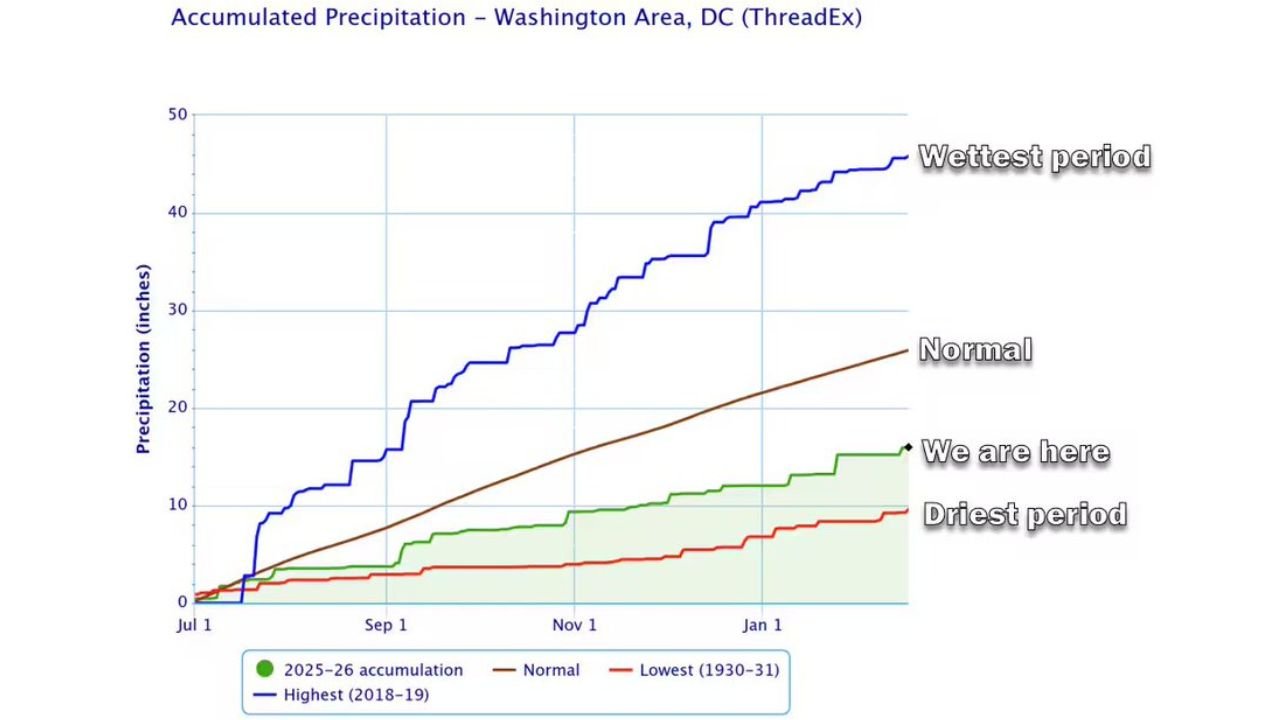
Even before the late-January snowstorm, the Baltimore and Washington region had entered January nearly 10 inches below normal rainfall following six consecutive dry months.
The accumulated precipitation chart for Washington, D.C. shows:
- The 2025–26 season tracking far below the long-term average.
- Current totals sitting well under the “normal” line.
- Conditions closer to historical dry years than wet ones.
In short, one winter storm cannot offset half a year of missing rain.
February Has Brought Limited Relief
February has offered only modest improvement. Sunday’s 0.71 inches of precipitation at National Airport marked the first measurable precipitation of the month.
Even with that event, the region remains approximately 0.75 inches below normal for February so far.
This continued shortfall reinforces why drought categories remain elevated despite visible snow cover.
Snow on the Ground Does Not Equal Drought Erased
It’s a common misconception that snowfall automatically ends drought. In reality:
- Snow water equivalent is often much lower than snow depth suggests.
- Gradual melting spreads moisture over time rather than delivering a rapid recharge.
- Groundwater systems require sustained above-normal rainfall over months to recover fully.
The accumulated precipitation graphic clearly shows the region still well below average, even after recent events.
What Would It Take to End the Drought?
To significantly improve drought conditions, the region would likely need:
- Multiple widespread soaking rain events.
- Above-normal precipitation over several consecutive months.
- Consistent replenishment of soil moisture and streamflow levels.
Until those factors align, drought classifications are unlikely to drop dramatically.
Bottom Line for Baltimore and Washington
Despite January snow and recent precipitation, the Baltimore and Washington metro areas remain in severe drought due to long-term rainfall deficits approaching 10 inches below normal. Snowfall provided some benefit, but not enough to reverse months of dryness.
Residents may see winter weather outside, but the numbers show the broader moisture shortage remains.
For continued weather and climate updates across the Mid-Atlantic and beyond, stay with WaldronNews.com.