
California, Nevada, Arizona, Utah, Colorado and New Mexico Face Rare March Heatwave as Temperatures Soar 20–30° Above Normal and All-Time Records Fall Across the Desert Southwest
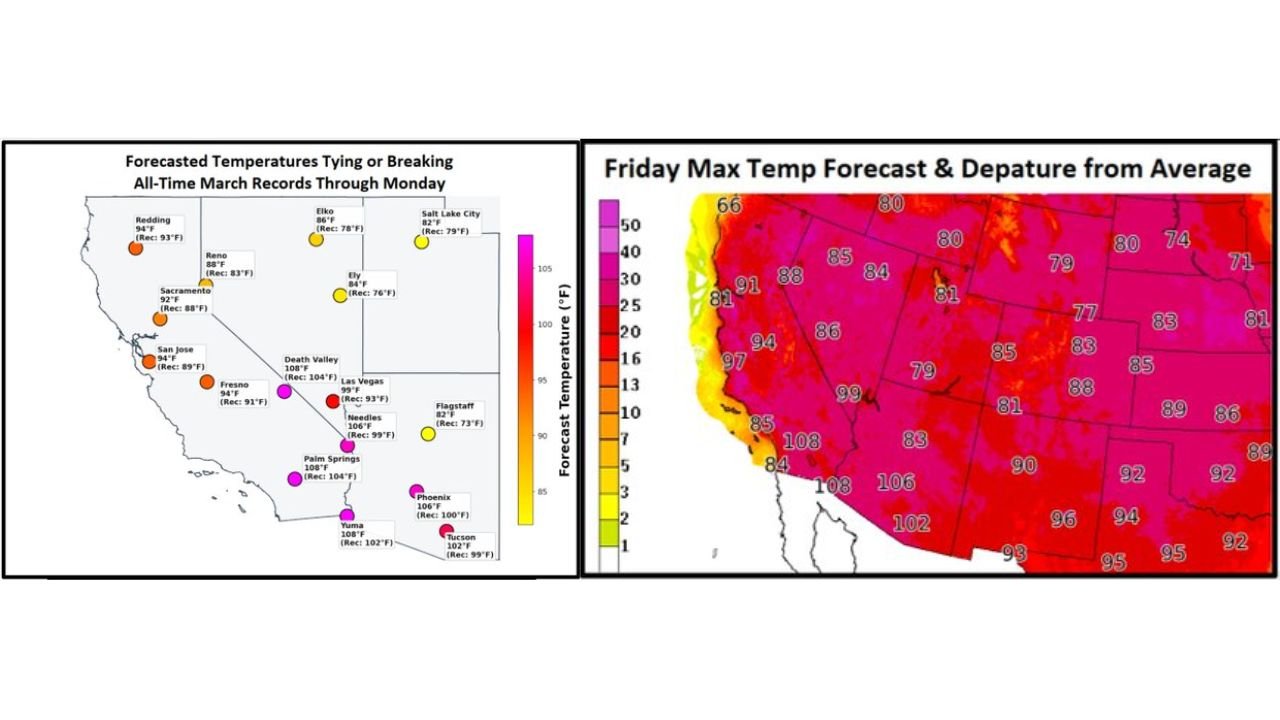
UNITED STATES — A rare and widespread early-spring heatwave is intensifying across the western United States, with temperatures running an astonishing 20 to 30 degrees above average and numerous cities forecast to tie or break all-time March records.
According to key messages issued Tuesday afternoon, this unusual weather pattern is expected to persist into early next week, bringing prolonged, summer-like heat to California, Nevada, Arizona, Utah, Colorado and New Mexico.
Forecasters warn that this event is not only about record-breaking numbers — it also carries significant health and snowmelt concerns.
Widespread Record-Breaking Temperatures Expected
Forecast maps show several major cities either tying or exceeding their historical March records:
- Palm Springs, CA: 108°F (Record: 104°F)
- Yuma, AZ: 108°F (Record: 102°F)
- Phoenix, AZ: 106°F (Record: 100°F)
- Tucson, AZ: 102°F (Record: 99°F)
- Las Vegas, NV: 99°F (Record: 93°F)
- Needles, CA: 106°F (Record: 99°F)
- Fresno, CA: 94°F (Record: 91°F)
- Reno, NV: 88°F (Record: 83°F)
- Salt Lake City, UT: 82°F (Record: 79°F)
- Denver, CO: 87°F (Record: 84°F)
- Albuquerque, NM: 91°F (Record: 85°F)
- Flagstaff, AZ: 82°F (Record: 73°F)
In several cases, records may be exceeded by 5 to 10 degrees or more, an extraordinary margin for established monthly climate benchmarks.
Temperatures Well Into the 90s and 100s
Large portions of the Desert Southwest are forecast to see afternoon highs deep into the 90s and triple digits — conditions typically reserved for late spring or summer.
Maps showing Friday’s maximum temperatures indicate widespread red and magenta shading across the region, signifying significant departures from seasonal norms.
Many locations are expected not only to break daily records, but also to set:
- All-time high temperatures for the month of March
- Their earliest 100°F reading on record
Increasing Heat Risk for Vulnerable Populations
Officials are emphasizing that the timing of this heatwave makes it particularly dangerous.
Because it is still early spring, many residents have not acclimated to extreme heat. Vulnerable populations — including the elderly, children, outdoor workers and those without reliable cooling — face elevated health risks.
The prolonged nature of the heat, combined with temperatures 20–30 degrees above normal, significantly increases the potential for heat-related illness.
Snowmelt and River Hazards Emerging
Beyond the heat itself, rapid snowmelt in mountainous regions is becoming a growing concern.
Hot air temperatures will accelerate melting across higher elevations, potentially leading to:
- Rising rivers
- Swift currents
- Increased runoff
Officials warn that while air temperatures are warm, river water remains dangerously cold. Entering mountain streams during rapid snowmelt can pose serious risks of cold water shock and hypothermia.
An Early-Season Event with Historic Implications
March is typically a transitional month across the West, often featuring lingering snowstorms in the Rockies and mild temperatures in desert regions.
Instead, this year’s pattern resembles a full-scale early summer heat dome.
Meteorologists describe the setup as rare, widespread, and potentially historic in scope — especially given the number of cities poised to challenge all-time March temperature records simultaneously.
As the heatwave continues into early next week, residents across California, Nevada, Arizona, Utah, Colorado and New Mexico are urged to take precautions, stay hydrated, and monitor local forecasts.
Stay with WaldronNews.com for continuing coverage of this developing and potentially historic Western heat event.