
Nevada’s Las Vegas Could Hit 100 Degrees in March for the First Time Since Records Began in 1937 as Historic Desert Heat Shatters Early-Season Limits
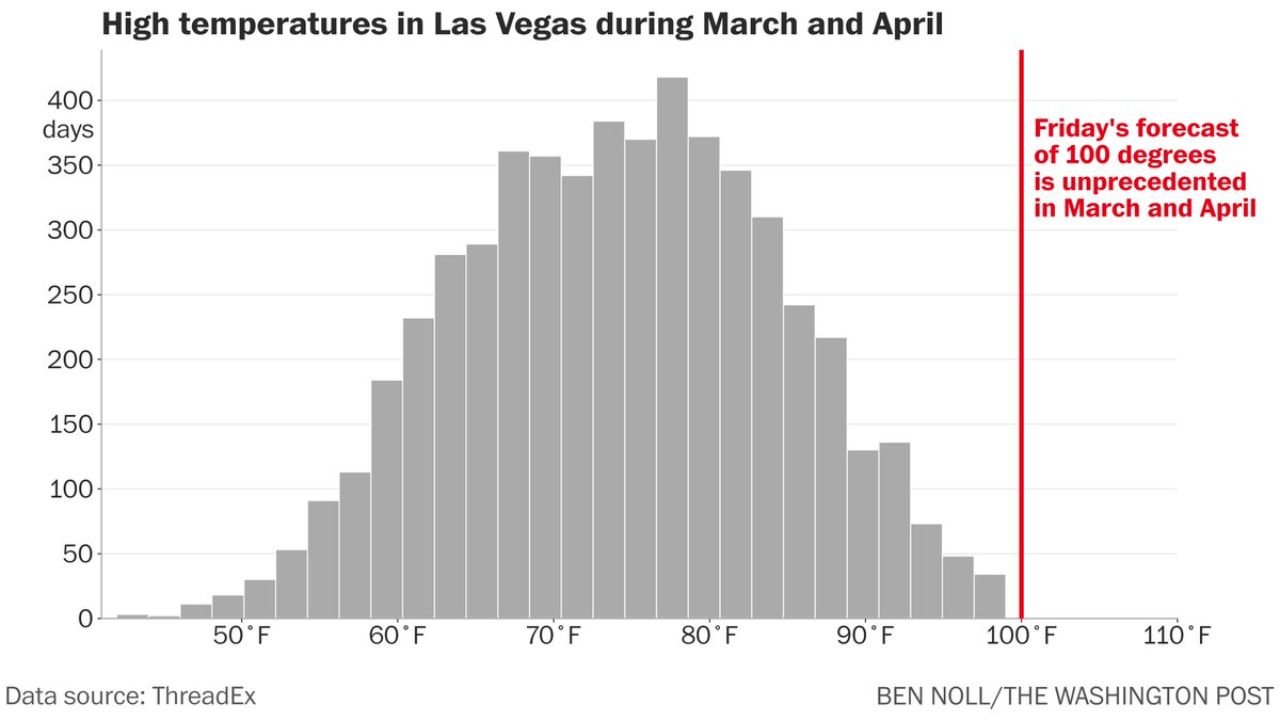
LAS VEGAS, NEVADA — Southern Nevada could be on the verge of weather history this week as Las Vegas approaches a temperature milestone that has never been recorded in March or April since official record-keeping began in 1937.
Forecast guidance indicates the city could reach 100 degrees on Friday, a level that has never occurred this early in the year in modern climate records.
A Barrier That Has Never Been Crossed
Historical temperature data for Las Vegas during March and April shows a clear ceiling — highs typically peak in the 70s and 80s, occasionally pushing into the 90s during strong early heat events.
But 100 degrees?
That line has remained untouched for nearly nine decades.
The distribution of past highs shows the overwhelming majority of March and April days fall between 65°F and 85°F, with only a small number reaching the low to mid 90s. The 100-degree mark stands completely outside the historical range for this time of year.
If Friday reaches triple digits, it would represent an unprecedented early-season heat event.
Why This Matters
Las Vegas regularly experiences extreme heat during the summer months, but early spring is typically far milder. Average highs in late March are generally in the upper 60s to low 70s.
A jump to 100 degrees would mean temperatures running 25 to 30 degrees above normal, signaling a powerful and unusually positioned ridge of high pressure dominating the Southwest.
Such an anomaly in March would not only break daily records — it would break seasonal expectations.
How Rare Is a 100° Reading This Early?
Since records began in 1937:
- No March high has ever reached 100°F.
- No April high has ever reached 100°F.
- Triple-digit heat historically begins much later in the year.
The visual temperature record distribution makes this clear: the 100-degree line sits entirely beyond the observed range for March and April.
This is not just a near-record event — it would establish a new benchmark for early-season heat in Las Vegas.
What’s Driving the Surge
Meteorologists point to a strong and expansive upper-level ridge parked over the Southwest, allowing desert air to compress and heat efficiently under clear skies.
Light winds, abundant sunshine, and dry atmospheric conditions are combining to maximize daytime heating.
With soil moisture limited and strong solar input, the environment is primed for extreme temperature spikes.
Potential Impacts
While Las Vegas is accustomed to summer heat, early-season triple-digit temperatures can catch residents off guard.
Possible impacts include:
- Increased energy demand
- Elevated heat stress risk for outdoor workers and vulnerable populations
- Early-season fire weather concerns in surrounding desert areas
If 100 degrees is reached, it will likely draw national attention as one of the earliest triple-digit readings ever observed in the region.
A Historic Desert Heat Moment
Las Vegas has experienced many extreme heat events — but never one like this in March or April.
Friday’s forecast could rewrite the city’s climate history and mark a significant milestone in early-season desert heat trends.
Stay with WaldronNews.com for updates as Las Vegas approaches what could become one of the most remarkable March temperature records in Nevada history.