
Pacific Northwest Snowpack Crisis Deepens: Washington, Oregon and Idaho Mountains Showing One of the Worst Snow Years Since the 1980s
UNITED STATES — The Pacific Northwest is enduring one of its weakest snowpack seasons since consistent records began in the 1980s, and new model data shows little sign of meaningful recovery as the window to rebuild mountain snow continues to shrink.
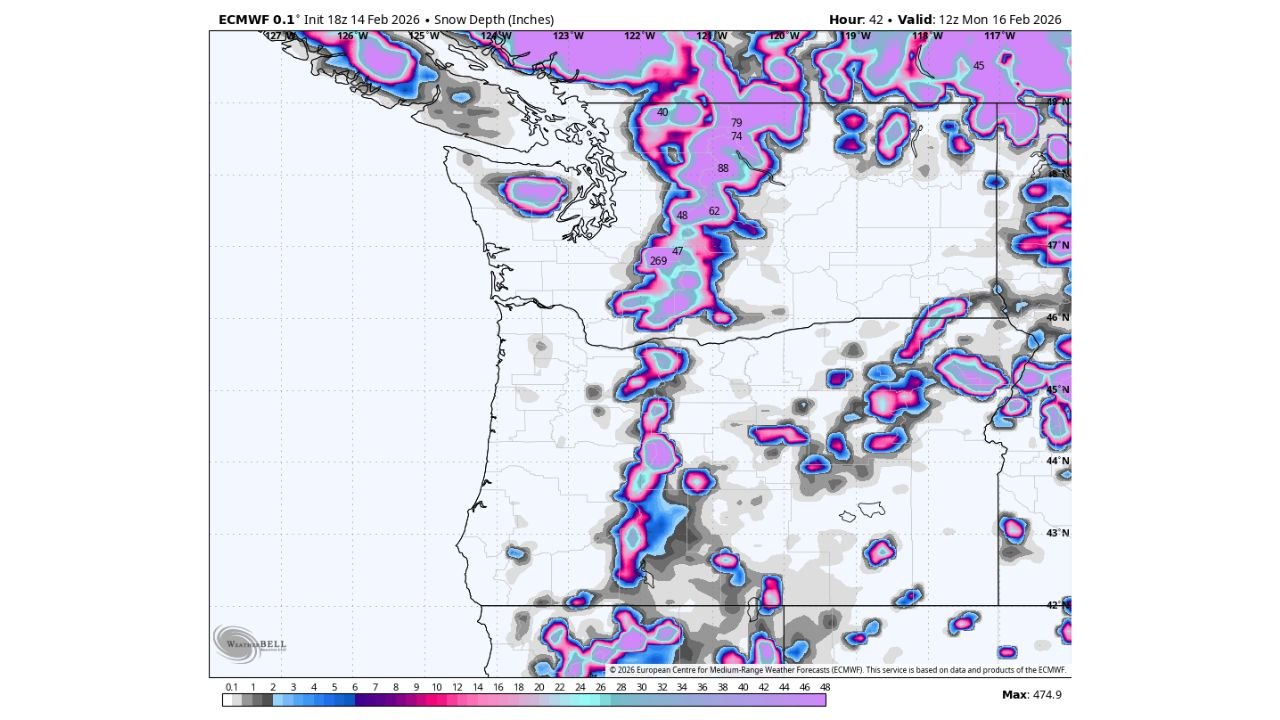
Recent snow depth projections valid mid-February show highly uneven coverage across Washington, Oregon and Idaho, with many lower-elevation and mid-elevation zones well below typical seasonal expectations.
Cascades and Interior Northwest Showing Patchy Snow Depth
ECMWF snow depth guidance highlights the primary snow accumulation confined to higher terrain, with the deepest snowpack centered in:
- The Washington Cascades, particularly central and northern sections
- The northern Idaho Panhandle
- Portions of western Montana just east of Idaho
While some higher peaks are showing snow depths of several feet, the broader picture across lower and mid-elevations is far less encouraging. Large stretches of western and central Oregon show minimal accumulation outside of the higher Cascade spine.
In many areas west of the Cascades and throughout interior valleys, snow depth remains extremely limited for mid-February.
Downward Trend Continuing Despite Recent Pattern
Even the most recent storm cycles have failed to significantly boost regional totals. The data suggests:
- Snow remains confined to narrow mountain corridors
- Broader regional coverage is lacking
- Snowpack is not expanding meaningfully south into Oregon
This is especially concerning because February is typically one of the prime snow-building months for the Pacific Northwest.
Without sustained storm cycles delivering colder, moisture-rich systems, the region risks finishing the season well below average.
Running Out of Time for Seasonal Recovery
Historically, March can still deliver meaningful snowfall to the Cascades and northern Rockies. However, the time available to approach normal seasonal snowpack levels is narrowing quickly.
Hydrologically, this raises concerns for:
- Spring snowmelt timing
- Reservoir replenishment
- Summer water availability
- Agricultural irrigation planning
The Pacific Northwest depends heavily on mountain snowpack to regulate streamflow and maintain water supplies through the dry summer months.
Washington and Northern Idaho Still Holding the Most Snow
The deepest snow concentrations appear in:
- Central and northern Washington Cascades
- The Selkirk and Cabinet Mountains near the Idaho-Washington border
- Higher elevations of western Montana
Even there, snow distribution appears uneven rather than widespread.
Meanwhile, much of western Oregon and southern Washington shows significantly thinner coverage than typical for mid-February.
Long-Term Context: One of the Weakest Since the 1980s
Reliable snowpack recordkeeping in the region dates back to the 1980s, and early indicators suggest this winter may rank among the weakest in that era.
If the downward trend continues through late February and early March, 2026 could solidify as one of the lowest snowpack seasons in decades across portions of the Pacific Northwest.
What Needs to Happen Next
For meaningful recovery, the region would need:
- Repeated Pacific storm systems
- Consistently colder air masses
- Heavy mountain snowfall events
- Limited warm intrusions between systems
Without those ingredients aligning soon, the Pacific Northwest may enter spring with snowpack levels far below average.
The latest data underscores a sobering reality for Washington, Oregon and Idaho: the region is quickly running out of time to rebuild snowpack to normal levels.
WaldronNews.com will continue tracking Pacific Northwest snowpack trends and any late-season storm opportunities that could shift the outlook before winter’s end.