
Pennsylvania, New Jersey, Delaware and New York Could See Winter Return With Possible Snowfall as Cold Blast Targets East Coast March 16–21
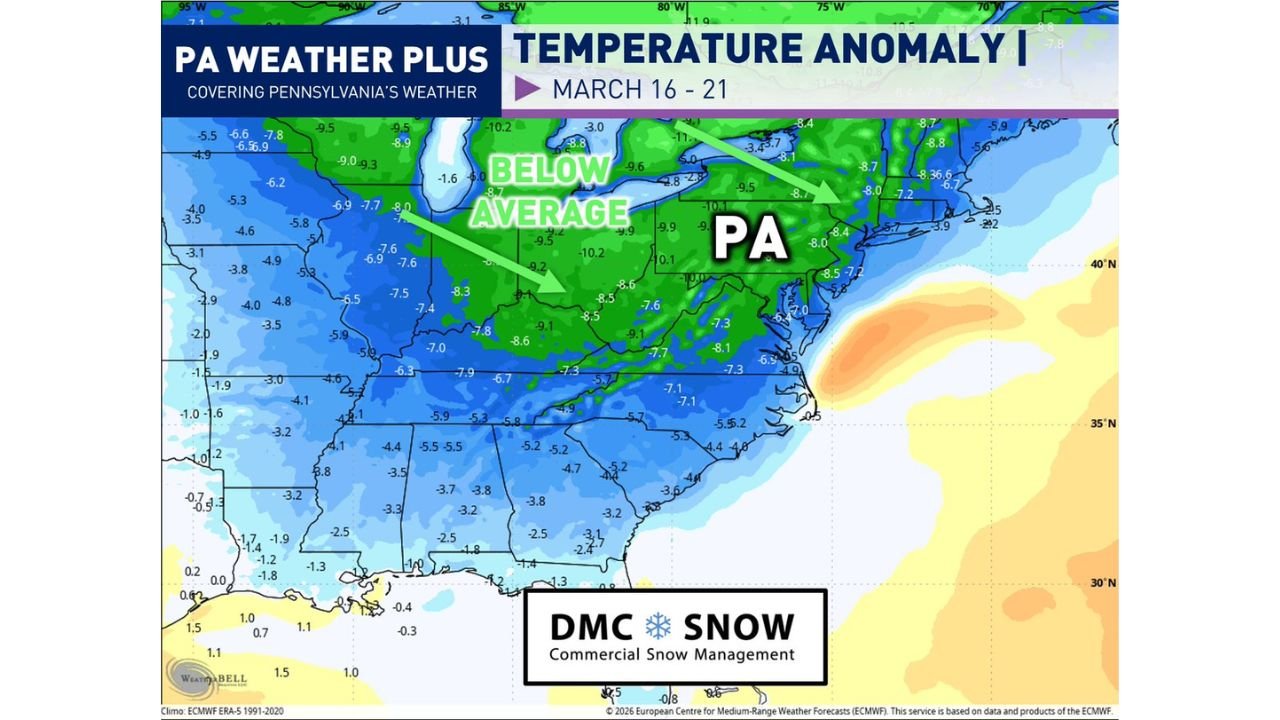
PENNSYLVANIA — A sharp pattern change may soon bring much colder temperatures back to the eastern United States, with forecasters warning that Pennsylvania, New Jersey, Delaware, New York and surrounding states could experience well below average temperatures between March 16 and March 21.
The developing pattern suggests that recent spring-like warmth across the region may only be temporary, as a strong cold front is expected to move through during the middle of the week before ushering in a colder regime across much of the East Coast.
Meteorologists say the upcoming pattern shift could create conditions favorable for late-season snowfall if moisture interacts with the incoming cold air mass.
Strong Cold Front Expected to Shift Weather Pattern
After several days of unusually warm temperatures, a strong cold front expected Wednesday night will likely bring cooler air back across the eastern United States.
Once the front passes, a colder pattern is projected to settle across:
- Pennsylvania
- New Jersey
- Delaware
- New York
- Maryland
- West Virginia
- Ohio
Forecast temperature anomaly projections show a broad region of below-average temperatures across much of the Northeast and Mid-Atlantic, especially during the March 16 through March 21 timeframe.
This shift could mark a return to late-winter conditions after an early taste of spring.
Below Average Temperatures Expected Across the Northeast
Forecast guidance indicates that much of the eastern United States could see temperatures several degrees below seasonal averages during this period.
The coldest anomalies appear focused across:
- Pennsylvania
- New York
- Ohio
- West Virginia
- New Jersey
These states may experience a stretch of cooler days as colder air settles across the region.
Forecasters emphasize that the coldest portion of the pattern may occur between March 16 and March 21, when temperatures are projected to dip well below normal levels.
Late Season Snowfall Still Possible in Mid-March
While snowfall becomes less common later in March, meteorologists say it is not unusual for late-season storms to develop when cold air and moisture align correctly.
In fact, forecasters note that during the past several years, parts of the Northeast have experienced significant snowfall events even after mid-March.
If a storm system moves into the region while the colder air is in place, some areas could still see measurable snow accumulation, and in certain cases snowfall totals of six inches or more are possible.
For heavier snow to develop, several factors would need to align, including:
- A storm system arriving at the same time as the cold air
- Adequate moisture available in the atmosphere
- Overnight timing that allows temperatures to remain cold enough for snow
Spring Warmth May Be Temporary
Forecasters say the recent warm weather across parts of the East Coast may represent what is sometimes referred to as “false spring” or “fool’s spring,” where temperatures briefly resemble spring or even early summer conditions before colder air returns.
Once the cold front moves through, temperatures could fall back closer to winter-like levels for several days.
Forecast Still Developing
Meteorologists stress that while the overall cold pattern appears increasingly likely, the exact timing and track of potential storm systems will determine whether significant snowfall develops.
Residents across Pennsylvania, New Jersey, Delaware, New York and neighboring states are encouraged to stay updated as the forecast evolves over the coming days.
Even though spring is approaching, forecasters warn that winter may not be finished just yet across the eastern United States.
Stay with WaldronNews for continuing updates as meteorologists track the developing late-season cold pattern across the Northeast and Mid-Atlantic.