
Phoenix, Arizona Sees +14°C Temperature Anomaly as Historic Western U.S. Heatwave Rivals 2021 Pacific Northwest Heat Dome
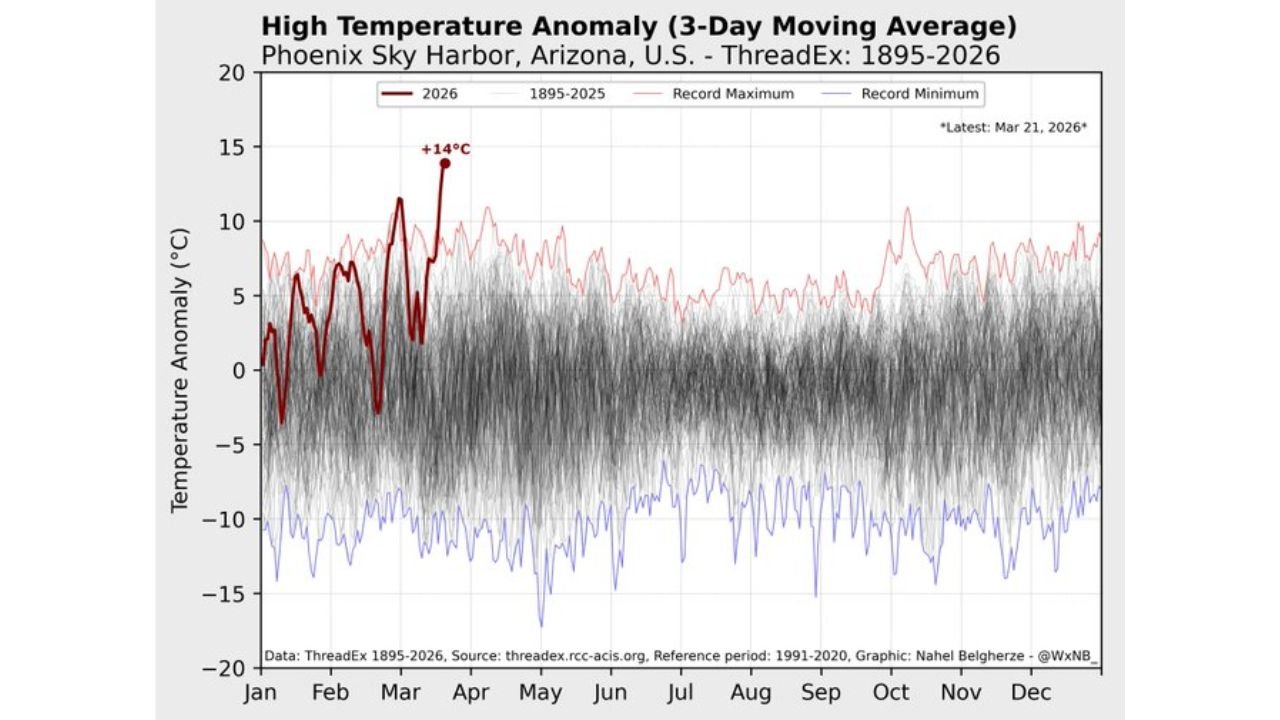
PHOENIX, AZ — The ongoing heatwave across the Western United States is reaching levels rarely seen in modern climate records, with Phoenix, Arizona recording a staggering +14°C (25°F) temperature anomaly in its latest three-day moving average — one of the most extreme departures ever observed this early in the year.
New long-term data from Phoenix Sky Harbor, which tracks temperature records back to 1895, show that March 2026 is not just warm — it is pushing into territory typically reserved for once-in-a-generation events.
Anomaly Off the Charts
The three-day moving average high temperature anomaly at Phoenix Sky Harbor peaked near +14°C above normal as of March 21, 2026.
To put that into perspective:
- Most years fluctuate within a narrow band near average.
- Even strong warm spells in past decades rarely approach double-digit Celsius departures.
- This event is nearing the upper envelope of historical record maximums for late March.
The chart comparing 2026 to every year from 1895–2025 shows the current spike nearly touching — and in some cases exceeding — prior record maximum anomaly thresholds.
Why This Is So Significant
Phoenix routinely sees extreme summer heat, but such dramatic departures from normal in March are far less common.
This multi-day surge is being described by analysts as possibly the most impressive Western U.S. heat event since the 2021 Pacific Northwest heat dome, which shattered long-standing records across Washington and Oregon.
Unlike a one-day spike, this event has persisted across several days — increasing its overall impact.
Broader Western U.S. Heat Pattern
The heatwave is not isolated to Phoenix. Much of:
- Arizona
- Southern California
- Nevada
- Utah
- Parts of Colorado
are experiencing widespread record-challenging temperatures.
However, Phoenix stands out due to the magnitude of its anomaly relative to its long-term historical baseline.
What a +14°C Anomaly Means
A temperature anomaly of +14°C indicates that average high temperatures over a three-day span are running roughly 25°F above the 1991–2020 climate normal.
Such extreme departures can accelerate:
- Early-season drought stress
- Snowpack melt in higher elevations
- Increased fire weather risk
- Strain on power infrastructure
Historic Context Dating Back to 1895
With more than 130 years of temperature records, Phoenix has experienced many heatwaves. But events of this magnitude in March are rare.
The data show that the current anomaly is pressing against the upper bound of all previously recorded late-March warmth.
Is This Event Truly “Unprecedented”?
While the word “unprecedented” is often overused, the data suggest this Western heatwave ranks among the most extreme early-spring events in modern U.S. history.
For Phoenix, the sustained +14°C anomaly places March 2026 in the upper tier of temperature extremes observed since recordkeeping began.
Bottom Line
Phoenix, Arizona is experiencing one of its most extreme March heat anomalies on record, as a historic Western U.S. heatwave rivals the magnitude of the 2021 Pacific Northwest heat dome.
The combination of persistence, intensity and geographic coverage makes this a remarkable early-season climate event.
Stay with WaldronNews.com for continued updates as record-challenging heat grips Arizona and the broader Western United States.