
Phoenix, Arizona Shatters 100+ Years of Heat Records, Three Consecutive Days at 105°F in March, Obliterating Previous Record by More Than 40 Days
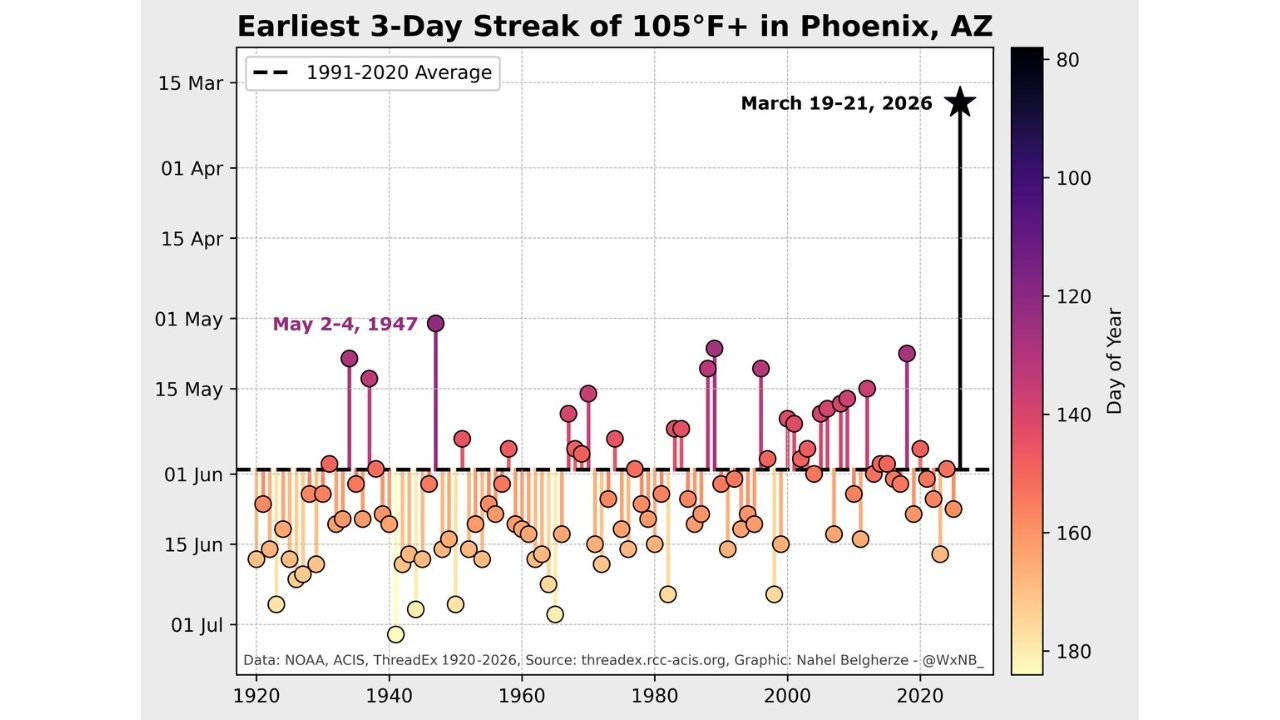
PHOENIX, ARIZONA — Before this month’s historic heatwave, Phoenix, Arizona had never — in over a century of recorded weather history — logged three consecutive days at 105°F (40.6°C) or above in the month of March. That record no longer exists. The March 19–21, 2026 heatwave did not just break the previous mark — it obliterated it by more than 40 days, pushing the earliest-ever 3-day streak of 105°F or higher from early May all the way back to mid-March in a single event. Climate scientists and meteorologists are calling it deeply shocking.
The data, sourced from NOAA, ACIS and ThreadEx records dating back to 1920, shows just how far outside the bounds of recorded history this event truly was — a lone black star sitting isolated at the very top of a chart that spans more than 100 years.
What the Record Actually Means
To understand the magnitude of this record, it helps to know what Phoenix, Arizona’s historical baseline looks like for extreme heat in March:
- Previous earliest 3-day 105°F+ streak: May 2–4, 1947 — the record that stood for 79 years
- 1991–2020 climatological average for the first 3-day 105°F+ streak: Around June 1 — shown as the dashed line on the historical chart
- March 19–21, 2026: The new record — arriving more than 40 days earlier than the previous all-time earliest mark
- Gap from climatological average: The new record fell more than 10 weeks before the typical date for Phoenix’s first 105°F+ three-day stretch
- Historical data span: NOAA and ThreadEx records dating to 1920 — more than 100 years of Phoenix temperature data
In every year from 1920 through 2025, Phoenix had never seen a three-day run of 105°F or higher before the month of May. The March 19–21, 2026 event did not just push that boundary — it leapfrogged it entirely, landing in a calendar position that no previous year in recorded history had come remotely close to reaching.
Why This Record Is So Extraordinary
The ThreadEx historical chart — which plots the date of the earliest 3-day 105°F+ streak for every year since 1920 — tells the story with stark visual clarity. Virtually every data point in the entire dataset clusters between late May and early July, with the 1991–2020 climatological average falling around June 1. The 1947 record of May 2–4 stood alone at the top of the chart for nearly eight decades as the earliest such streak ever recorded.
Then comes March 19–21, 2026 — plotted as a lone black star floating more than 40 days above the previous record holder, detached from the entire historical distribution in a way that has no precedent in Phoenix, Arizona’s more than century-long temperature record.
To put the 40-day gap in perspective: the difference between the 2026 record and the 1947 record is larger than the difference between the 1947 record and the climatological average. This is not a record that was nudged forward by a week or two. It was rewritten in a completely different part of the calendar.
Phoenix’s Place in the Broader 2026 Heat Story
The March 19–21, 2026 event in Phoenix, Arizona did not occur in isolation. It was part of a historic and widespread western United States heat event that shattered temperature records across California, Nevada and Arizona during the third week of March. The combination of an anomalously strong and persistent high-pressure ridge over the Southwest and a near-complete absence of cloud cover allowed surface temperatures to climb to levels that are simply not supposed to occur in Phoenix in mid-March — a full season removed from the city’s typical peak heat period of June through August.
What to Watch Next
As Phoenix, Arizona and the broader Southwest digest the magnitude of this record:
- Climate trend analysis — researchers will be examining how the 2026 Phoenix March heatwave fits into the longer-term trend of warming in the Southwest United States
- ThreadEx and NOAA record updates — official verification of the March 19–21 records across the Phoenix metro
- April and May outlook — whether the pattern that produced this historic March heat has any implications for the upcoming summer heat season in Phoenix
- Infrastructure and health impact review — how the early-season extreme heat affected vulnerable populations and energy systems in Phoenix and Maricopa County
Phoenix, Arizona residents and climate watchers should understand that what happened on March 19–21, 2026 was not a statistical outlier at the edge of the historical distribution — it was an event that existed in a category entirely its own, separated from everything that came before it by more than 40 days on the calendar.
WaldronNews.com will continue tracking the climate and weather story of Phoenix, Arizona’s record-shattering March 2026 heatwave and provide updates as researchers and meteorologists publish further analysis.