
Southeast Missouri and Northeast Arkansas Record Unprecedented Tornado Density With 32 Confirmed Tornadoes Inside 75-Mile Radius
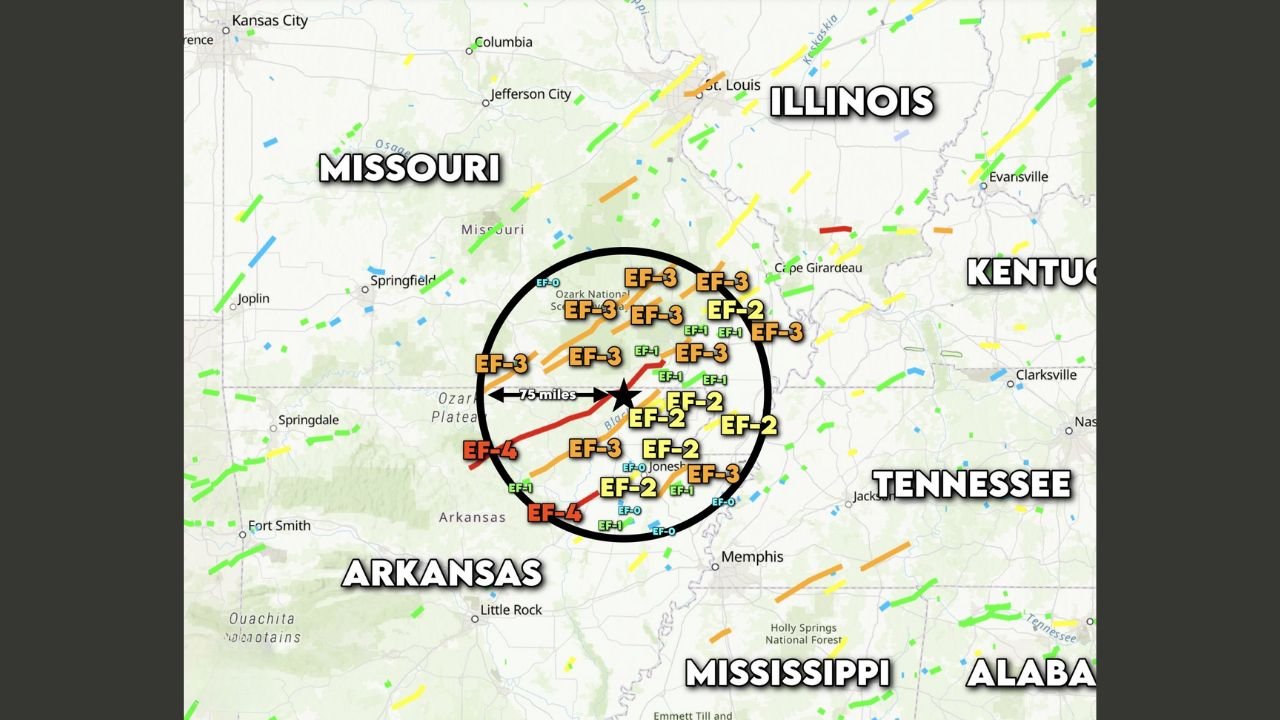
SOUTHEAST MISSOURI — New storm analysis highlights an extraordinary concentration of tornado activity across parts of southeast Missouri and northeast Arkansas, where 32 confirmed tornadoes have occurred within a 75-mile radius, marking one of the most intense localized tornado clusters in recent history.
The data shows an unusually high number of strong and violent tornadoes packed into a relatively small geographic area, creating a level of exposure that meteorologists describe as exceptionally rare.
Breakdown Shows High-End Tornado Strengths
Within the 75-mile circle highlighted on the map, confirmed tornado ratings include:
- 6 EF-2 tornadoes
- 10 EF-3 tornadoes
- 2 EF-4 tornadoes
The presence of multiple EF-3 and EF-4 tornadoes in such close proximity underscores the severity of the storm pattern that repeatedly affected this region.
EF-3 tornadoes are capable of causing severe structural damage, while EF-4 tornadoes can result in devastating destruction, including the leveling of well-built homes.
Exceptional Density Raises Long-Term Risk Concerns
To put the scope into perspective, the data suggests that residents in parts of southeast Missouri and northeast Arkansas have experienced a dozen significant tornadoes within roughly an hour’s drive of one another.
Such clustering dramatically increases the likelihood of repeated impacts to communities, infrastructure, and emergency response systems, especially when storms occur during overnight hours or across multiple outbreak events.
Regional Context Highlights Rarity of Event
While tornadoes are not uncommon in the broader Mid-South, the density and intensity shown here stands out even by historical standards. Having 32 confirmed tornadoes, including high-end EF-rated storms, inside a confined radius represents a statistical outlier rather than a typical seasonal pattern.
The map also shows how this activity sits near state borders, emphasizing how storm impacts often extend beyond county or state lines and affect entire regions simultaneously.
Why This Matters Going Forward
Meteorologists use analyses like this to better understand how atmospheric patterns are evolving, particularly when strong tornadoes occur repeatedly in the same corridors. Such data can influence future forecasting techniques, warning strategies, and community preparedness planning.
For residents, the takeaway is clear: areas that experience clustered tornado activity may face elevated long-term risk, making preparedness, warning awareness, and shelter planning increasingly critical.
If you live in or near southeast Missouri or northeast Arkansas and experienced any of these storms, or if you have insight into how repeated tornado activity has affected your community, share your perspective and stay with WaldronNews.com for continued weather analysis, regional impact coverage, and severe weather updates.