
Why Indiana and Ohio Saw 12–18 Inches of Snow: How Cold Temperatures and High Snow-to-Liquid Ratios Drove Massive Winter Storm Totals
UNITED STATES — As winter storms continue to impact large portions of the country, one of the most misunderstood aspects of snowfall forecasting is snow-to-liquid ratio, often referred to as SLR. While many people assume colder temperatures automatically mean heavier snow, the reality is more nuanced — and understanding SLR helps explain why some storms produce towering snow totals while others barely coat the ground.
Recent winter storms across the Midwest and Ohio Valley have provided a textbook example of how temperature, snow structure, and moisture efficiency work together to determine final snowfall amounts.
What Is Snow-to-Liquid Ratio?
Snow-to-liquid ratio measures how many inches of snow fall for every inch of liquid water produced by a storm.
In simple terms:
- Lower ratios = heavier, wetter snow
- Higher ratios = lighter, fluffier, powdery snow
The classic “average” snowfall ratio used in forecasts is 10:1, meaning 10 inches of snow equals 1 inch of liquid water. However, real-world storms often deviate significantly from that average.
How Temperature Changes Snowfall Efficiency
Temperature is the primary driver of snow-to-liquid ratios, though it is not the only factor.
Based on observed data and recent storm analysis:
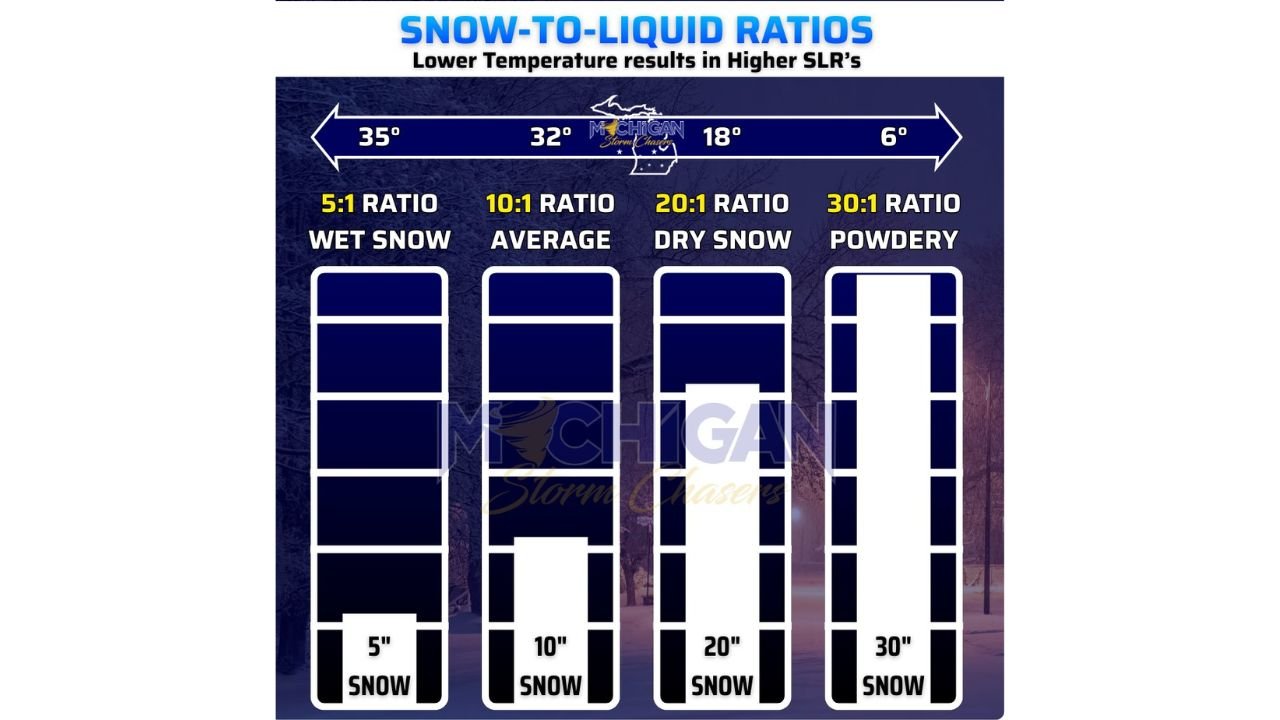
- Around 35°F → 5:1 ratio (Wet snow)
Heavy, dense snow that compacts quickly and melts on contact. - Near 32°F → 10:1 ratio (Average snow)
Typical winter snow that accumulates steadily but settles over time. - Around 18°F → 20:1 ratio (Dry snow)
Light, fluffy snow that accumulates efficiently and piles up quickly. - Near 6°F → 30:1 ratio (Powdery snow)
Extremely light snow crystals that produce impressive totals with very little moisture.
This is why two storms with the same amount of moisture can produce vastly different snowfall totals depending on temperature.
Why Colder Doesn’t Always Mean More Snow
A key misconception is that very cold surface temperatures guarantee heavy snow. In reality, cold air alone is not enough.
Several other factors influence snowfall totals:
- Vertical temperature profiles
- Crystal growth zones within the cloud
- Lift and mesoscale banding
- Moisture availability within the system
For example, it’s possible to see temperatures near 18°F but only 0.5 inches of liquid equivalent during a storm. Even with a high 20:1 ratio, that still limits snowfall to around 10 inches, not because snow growth was inefficient, but because moisture was limited.
Why Powdery Snow Produces Bigger Totals
Dry, powdery snow is far more efficient at accumulating than wet snow.
Wet snow:
- Compacts easily
- Melts on contact with roads and surfaces
- Reduces measured totals over time
Powdery snow:
- Stacks rapidly
- Does not compact as easily
- Preserves higher snowfall measurements
This efficiency explains why recent winter storms dropped 12–18 inches across parts of Indiana and Ohio even though liquid precipitation amounts were relatively modest. Temperatures in the upper teens allowed snowflakes to grow efficiently and accumulate quickly.
The Ideal Snowfall Temperature Range
Meteorologists note that snow forms most efficiently when surface temperatures fall between 0°F and 10°F, assuming sufficient moisture and lift are present. Colder temperatures favor lighter crystal structures, which maximize snowfall depth relative to liquid content.
This temperature range often produces the most visually impressive and high-impact snowstorms, especially when strong lift persists for several hours.
Why Snow-to-Liquid Ratios Matter for Forecasting
Understanding SLR helps explain why snowfall forecasts can change dramatically — even when storm tracks stay the same.
Small shifts in temperature can:
- Double or halve expected snowfall totals
- Change snow from heavy and slushy to light and powdery
- Alter road conditions and travel impacts significantly
For forecasters, accurately estimating snow ratios is just as important as predicting storm track and precipitation amounts.
Final Takeaway
Snowfall totals are not just about how much moisture falls — they’re about how efficiently that moisture turns into snow. Colder storms with high snow-to-liquid ratios can produce huge accumulations from relatively little moisture, while warmer storms struggle to pile snow up at all.
As winter continues, understanding these ratios helps explain why some storms surprise with massive totals — and why others underperform despite cold conditions.
Would you like to see more weather education explainers like this? Let us know, and stay with WaldronNews for clear, data-driven coverage of winter weather and forecasting science.