
Winter Forecast Confidence Dispute Highlights Diverging Outcomes Across Texas, Gulf Coast States, Southeast, Midwest, and Northeast
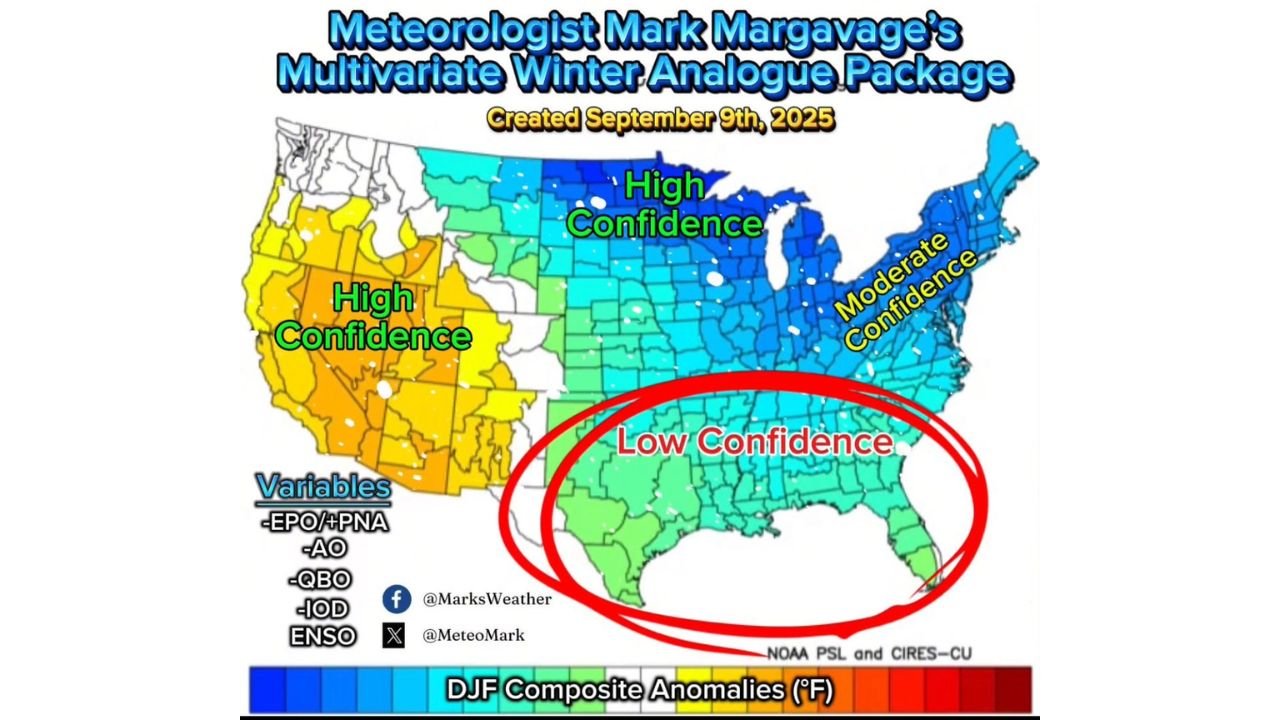
UNITED STATES — A winter forecast shared by Meteorologist Mark Margavage is drawing renewed attention as ongoing winter conditions challenge earlier seasonal outlooks issued by the Climate Prediction Center (CPC), particularly across the Eastern United States.
According to Margavage, his winter outlook—released in early September—was initially criticized by peers who labeled it “wishcasting.” However, as winter unfolded, he argues that the actual atmospheric behavior aligned more closely with his forecast analogs than with the CPC’s warmer Eastern U.S. outlook, which had been dominated by orange shading at the time.
Analog Years Used to Shape the Winter Outlook
Margavage’s winter forecast relied on a set of historical analog years he believed closely matched the large-scale climate signals leading into the season. Those years included:
- 1993–94
- 1995–96
- 2002–03
- 2013–14
- 2024–25
These analogs were chosen to represent similar global and hemispheric patterns rather than short-term weather trends. At the time, critics questioned the approach, but Margavage maintains that the analog-based forecast has proven more reliable as winter progressed.
Confidence Levels Vary Sharply by Region
The accompanying winter outlook map divides the United States into confidence zones rather than direct snowfall or temperature guarantees.
- High confidence is shown across much of the Western United States, where signals were clearer and more consistent.
- Moderate confidence appears across the Northeast and parts of the Great Lakes, suggesting reasonable predictability but room for variability.
- A large low-confidence zone spans the Southern and Southeastern United States, including Texas, the Gulf Coast states, and portions of the Southeast.
The low-confidence designation reflects greater uncertainty in how winter patterns would evolve in these regions, not a lack of potential impact.
Why the CPC Outlook Fell Short, According to the Forecast
Margavage directly contrasts his approach with the CPC’s seasonal outlook, which had painted much of the Eastern U.S. as warmer-than-average heading into winter. He argues that:
- Seasonal outlooks relying too heavily on averaged signals can miss pattern-driven cold intrusions
- Analog-based forecasting, when used carefully, can better capture high-impact winter variability
- Regional confidence matters more than broad national shading
As winter unfolded, colder conditions across portions of the East prompted renewed scrutiny of the CPC’s early guidance.
A Broader Conversation in the Weather Community
The exchange highlights an ongoing debate within meteorology: statistical outlooks versus pattern recognition and analog forecasting. While no seasonal forecast is perfect, the situation underscores how different methodologies can lead to very different expectations—and public messaging.
Margavage closed his commentary by questioning how those who dismissed his outlook are reacting now, suggesting that real-world conditions have validated his original concerns.
What This Means Going Forward
For readers, the takeaway is not that one method is flawless, but that seasonal forecasts carry inherent uncertainty, especially across transitional regions like the Eastern and Southern U.S.
As winter continues, forecasters emphasize the importance of:
- Monitoring short- and medium-range forecasts
- Understanding confidence zones, not just temperature colors
- Recognizing that long-range outlooks are guidance—not guarantees
WaldronNews.com will continue to track winter pattern discussions, forecast verification, and evolving outlooks as the season progresses.