
Louisiana, Texas, Florida and North Carolina Show Shortest Hurricane Return Periods While Maine and California Exceed 100+ Years
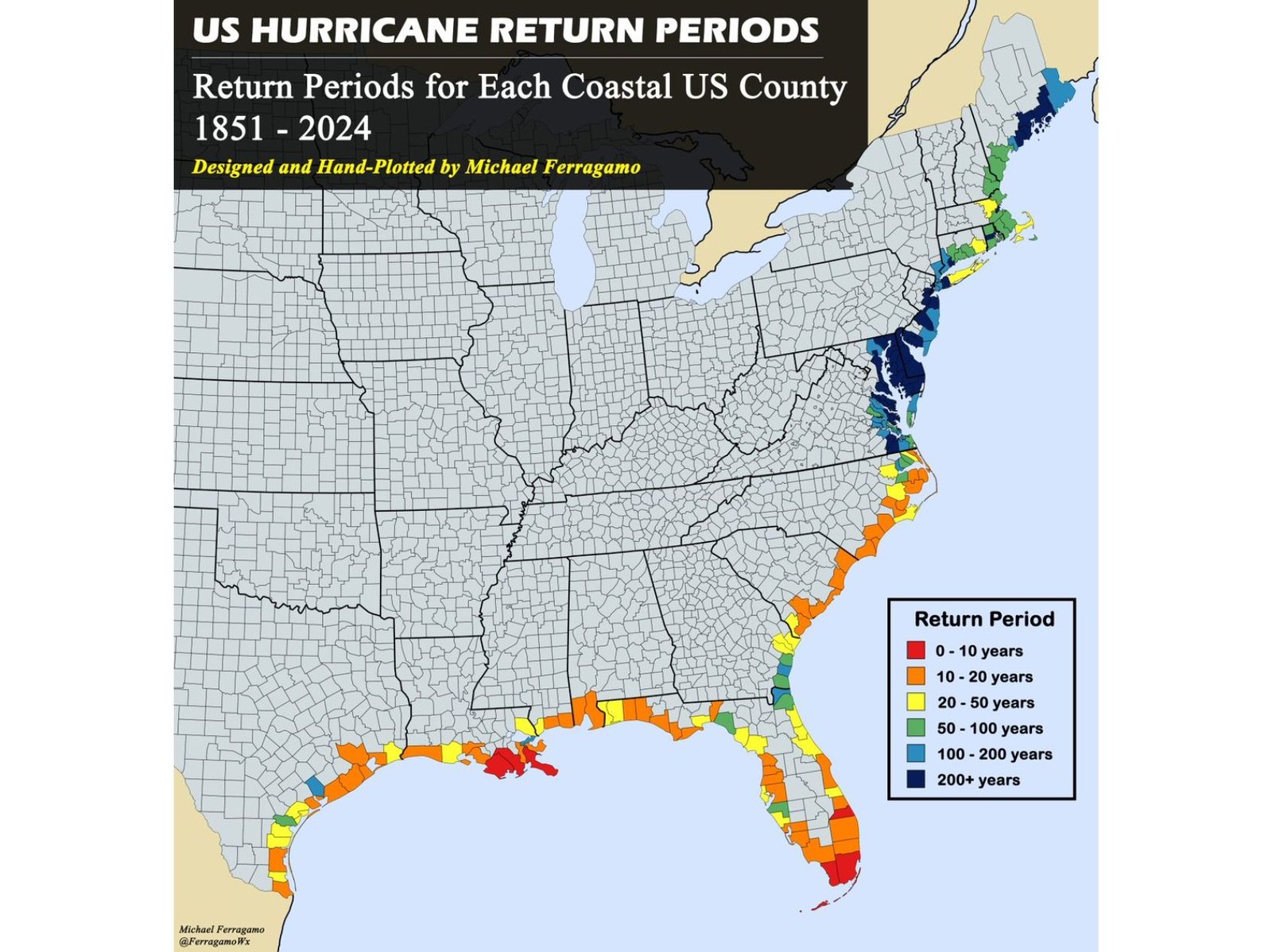
UNITED STATES — A newly released county-by-county map analyzing hurricane return periods from 1851 through 2024 reveals stark contrasts in how often coastal communities across the U.S. experience hurricane-force winds.
The updated map focuses not just on landfall points, but on the average return period of hurricane-force winds for every coastal county — offering a smoother and more physically representative look at long-term risk.
Gulf Coast: Most Frequent Hurricane Impacts
The shortest return periods — meaning hurricanes strike more frequently — are concentrated along portions of the Louisiana, Texas and Florida Gulf Coasts.
Highlighted in red (0–10 years), some counties in southern Louisiana show average hurricane-force wind impacts as often as once every decade or less.
Large stretches of:
- Coastal Texas
- Southern and central Louisiana
- Western Florida Panhandle
- Southwest Florida
fall into the 10–20 year range (orange), indicating relatively frequent exposure compared to the rest of the country.
Florida: High Frequency on Both Coasts
Much of Florida’s southern peninsula, particularly along the Atlantic side and parts of the Gulf Coast, appears in the 10–20 year category.
Some sections of the Florida Keys and far South Florida trend toward shorter return intervals compared to northern parts of the state.
Meanwhile, portions of northeast Florida shift into the 20–50 year range, reflecting somewhat less frequent hurricane-force wind impacts compared to the southern tip.
Carolinas: Moderate but Regular Risk
Along North Carolina and South Carolina, many coastal counties fall into the 10–20 year and 20–50 year categories.
The Outer Banks and portions of southeastern North Carolina show comparatively shorter return periods than much of the Mid-Atlantic.
Mid-Atlantic and Northeast: Much Longer Return Periods
Moving northward into:
- Virginia
- Maryland
- Delaware
- New Jersey
- New York
- Connecticut
- Rhode Island
- Massachusetts
- Maine
return periods lengthen significantly.
Many counties in the Northeast fall into the 50–100 year, 100–200 year, or even 200+ year categories, indicating that hurricane-force winds are far less common than along the Gulf Coast.
Parts of coastal Maine and northern New England are shown in the 200+ year range.
California: Rare Hurricane Impacts
Along California’s coastline, most counties fall into extended return periods exceeding 100 years, reflecting the rarity of true hurricane-force wind events reaching the state under current climate patterns.
Why This Map Matters
Rather than simply counting direct landfalls — where the center of the storm passes overhead — this updated approach calculates the average return period of hurricane-force winds affecting each coastal county since 1851.
That methodology better reflects how storms can impact wide areas beyond the precise landfall point.
The result highlights a clear gradient:
- Highest frequency along the central Gulf Coast
- Moderate frequency along Florida and the Carolinas
- Significantly lower frequency across the Mid-Atlantic and Northeast
- Extremely rare occurrences along the West Coast
The Bottom Line
Coastal counties in Louisiana, Texas and Florida face the most frequent hurricane-force wind impacts in the United States, with some areas averaging events within a decade. In contrast, counties in Maine, California and parts of New England experience such winds only once every century or longer.
The updated return-period approach provides a broader perspective on long-term hurricane risk across America’s coastlines.
Stay with WaldronNews.com for continued weather and climate analysis from across the United States.