
New York, New Jersey, Illinois, Massachusetts, California, and Washington Lead U.S. in Public Transit Commuting as Most States Remain Car-Dependent
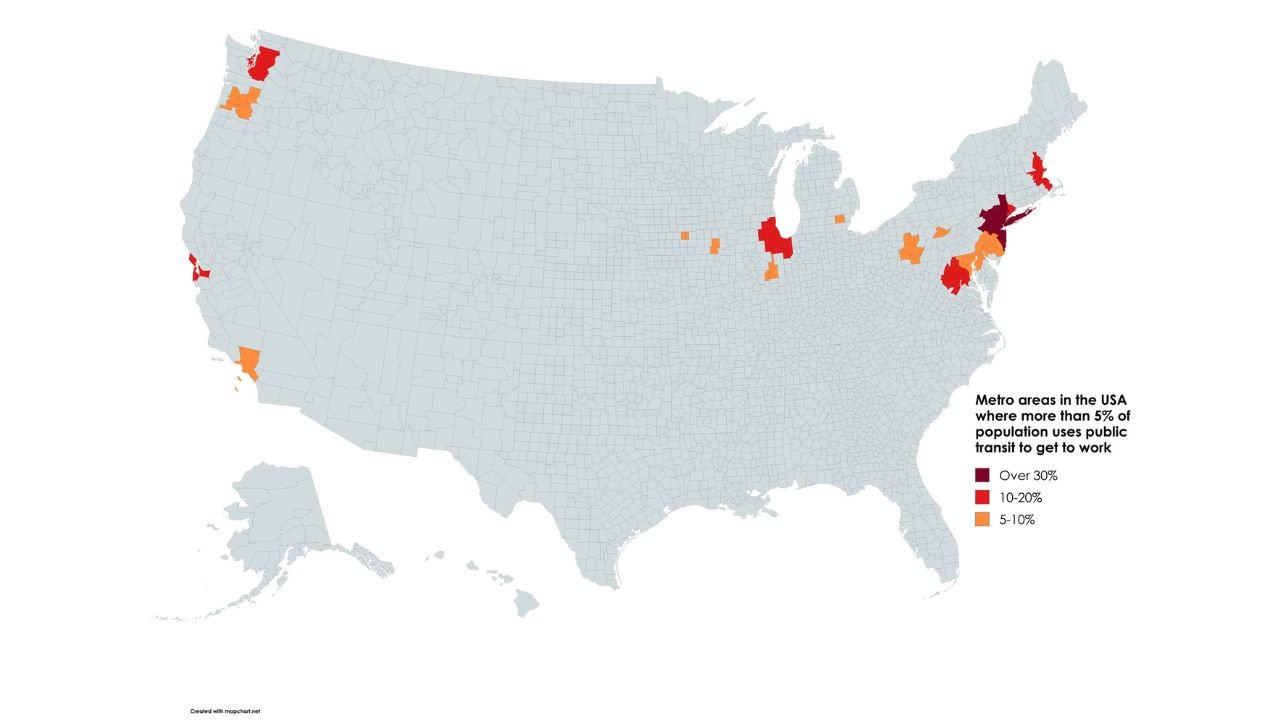
UNITED STATES — A new nationwide map highlighting metro areas where more than 5% of workers commute using public transportation underscores just how limited transit-dependent commuting remains across most of the country. The data shows that only a small number of U.S. metro regions exceed even modest public transit usage thresholds, with heavy reliance largely confined to a few dense urban corridors.
Most of the country remains dominated by car-based commuting, while transit use above 10% — and especially above 30% — is concentrated in specific, well-established metro systems.
Metro Areas With the Highest Public Transit Usage
The map shows that only one U.S. metro area exceeds the 30% threshold for public transit commuting: New York City and its surrounding metro region. This reflects decades of dense development, limited car space, and one of the most extensive transit networks in the world.
Several other metros fall into the 10–20% range, including:
- Washington, D.C.
- Boston
- Philadelphia
- Parts of New Jersey
- Chicago
- San Francisco
- Seattle
These metros share common traits: older urban layouts, rail-heavy transit systems, dense job centers, and high parking costs, all of which discourage car use.
The 5–10% Tier: Transit Use Exists, but Cars Still Dominate
A small number of metro areas fall into the 5–10% category, indicating some transit presence but continued reliance on personal vehicles. These include select areas in:
- Southern California
- The Pacific Northwest
- Parts of the Midwest and Northeast
In these regions, transit is often used by specific commuter corridors, rather than the majority of workers.
What the Map Reveals About U.S. Transportation Patterns
The most striking takeaway is how rare meaningful public transit usage remains nationwide. Vast portions of the Midwest, South, Mountain West, and Great Plains show little to no metro area exceeding the 5% mark, reinforcing how deeply car dependency is embedded in American commuting culture.
Urban planning experts note that transit use at scale typically requires:
- High population density
- Extensive rail or rapid bus systems
- Long-term infrastructure investment
- Policy support that limits car dominance
Without these factors, even large metro areas struggle to move the needle.
Why This Matters Going Forward
As cities debate infrastructure spending, climate goals, and housing development, this data highlights the challenge of shifting commuter behavior in the U.S. Expanding transit alone is often not enough; land use, zoning, and regional planning play equally critical roles.
For now, the map confirms that public transit commuting in the U.S. remains the exception, not the rule, concentrated in a small group of legacy transit metros rather than widespread nationwide adoption.
Stay with Waldron News for continued data-driven reporting on infrastructure, transportation trends, and how Americans move to work.