
Kentucky Bracing for Fast-Moving Saturday Storm Line as Damaging Winds Threaten Communities from Western to Central KY
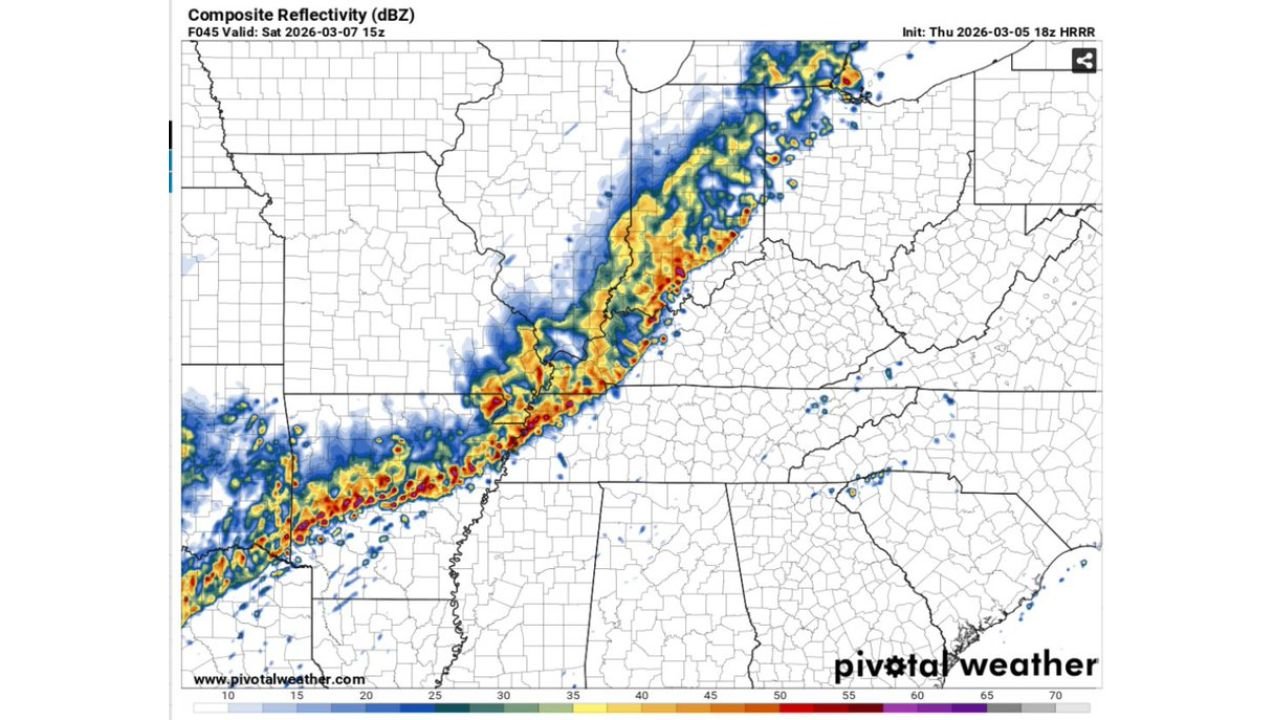
KENTUCKY — A fast-moving line of thunderstorms is expected to sweep across Kentucky on Saturday, with forecasters highlighting damaging straight-line winds as the primary threat as the system pushes in from the west. Early model guidance, including the high-resolution HRRR weather model, suggests a squall line forming across the Mid-South and racing northeast through the Ohio Valley, placing much of Kentucky directly in its path.
Meteorologists monitoring the developing setup say timing will play a major role in determining how intense the storms become, though the current expectation is that the line could reach western Kentucky sometime during the mid-morning to early afternoon hours.
Storm Line Expected to Enter Kentucky from the West
Weather model simulations show a long, organized band of thunderstorms stretching from Arkansas through western Tennessee and into the Mississippi Valley, gradually moving northeast. As this line advances, it is forecast to cross the Mississippi River and move into western Kentucky before continuing toward central and eastern parts of the state.
Radar simulations indicate a classic squall line structure, which often produces widespread wind damage as storms organize into a fast-moving band.
Communities in Paducah, Murray, Hopkinsville, Bowling Green, and areas surrounding the Land Between the Lakes region could be among the first to experience the storms before they continue toward Lexington, Frankfort, and Louisville later in the day.
Forecasters emphasize that these types of squall lines frequently travel faster than forecast models initially predict, meaning the storms could arrive earlier than expected.
Damaging Winds Highlighted as the Primary Risk
Analysis of atmospheric soundings from the model data suggests that strong winds aloft will be able to mix down to the surface, increasing the likelihood of damaging gusts.
The storm environment shows:
- Strong wind shear through the atmosphere
- A linear storm structure favoring wind damage
- Limited instability compared to major tornado outbreaks
Because of these ingredients, meteorologists say widespread wind damage is the most likely hazard, though isolated stronger storms could still produce brief severe conditions.
Wind gusts within the strongest storms could potentially reach 50 to 70 mph, capable of bringing down tree limbs, causing scattered power outages, and making travel hazardous during heavier downpours.
Timing May Limit or Increase Severe Potential
One of the biggest uncertainties remains exact storm timing.
Some weather guidance suggests the storms could arrive during the mid-morning hours, while other projections show them entering Kentucky closer to early afternoon.
If storms arrive earlier in the day, limited daytime heating could reduce the amount of instability available, slightly lowering the severe risk.
However, if the line holds off until later in the afternoon, additional atmospheric energy could fuel stronger storms, increasing the potential for damaging winds.
For now, many meteorologists believe mid-morning arrival remains the most likely scenario, which could help limit the overall intensity but still bring a period of strong storms across the state.
Fast-Moving Storms Could Shorten Warning Time
Another concern with squall line events is speed. These storms often move quickly, giving communities less time to react once warnings are issued.
Residents across Kentucky are encouraged to:
- Monitor local weather alerts Saturday morning
- Have multiple ways to receive severe weather warnings
- Secure loose outdoor items that could become airborne in strong winds
Even though the storms are expected to move through relatively quickly, the brief window of intense wind and heavy rain could still cause localized damage.
Another Active Weather Day for the Ohio Valley
The approaching system is part of a broader weather pattern bringing repeated storm chances across the central United States and Ohio Valley this week.
As the squall line tracks northeast, storms may continue into southern Indiana, Ohio, and parts of West Virginia later Saturday, extending the threat beyond Kentucky.
Meteorologists say conditions will continue to be monitored closely as newer model data arrives over the next 24 hours, which could refine storm timing and intensity forecasts.
Stay tuned to WaldronNews for the latest updates as Saturday’s storm system approaches Kentucky and the Ohio Valley.