
Western States Face Critically Low Snowpack Across California Nevada Utah Colorado and Idaho So Residents Should Prepare For Summer Water Shortages and Fire Risk Now
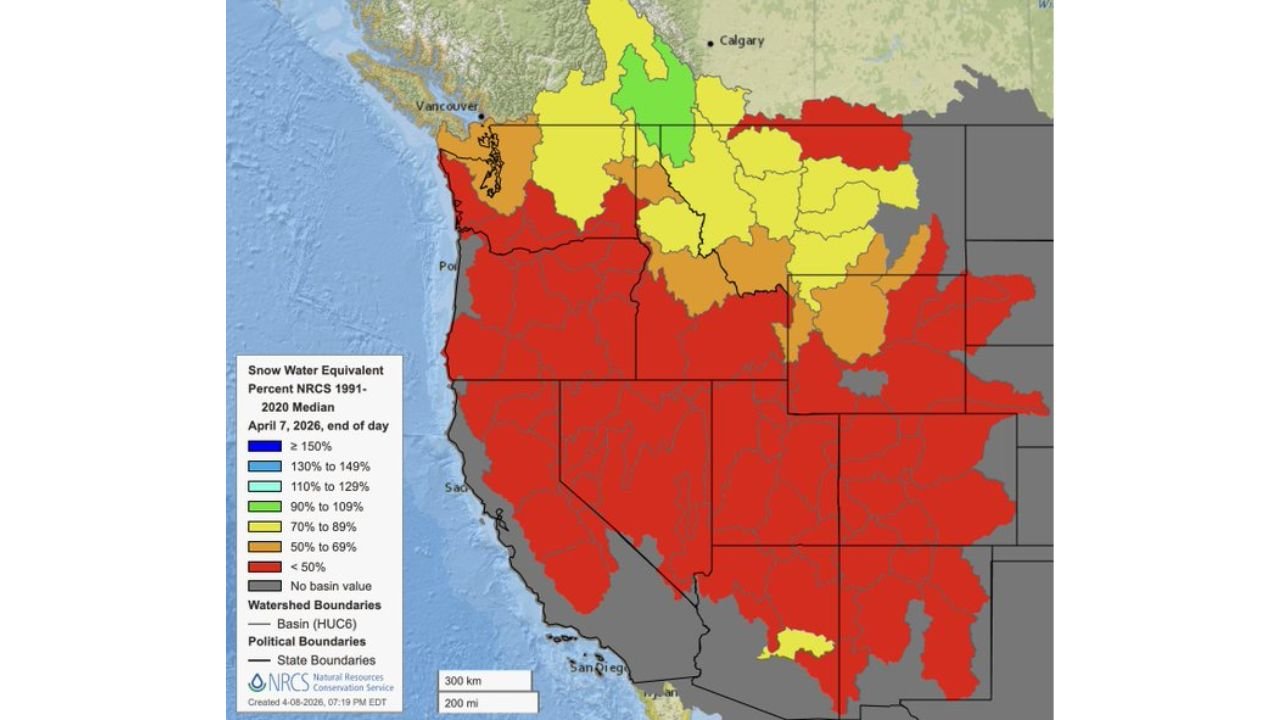
UNITED STATES — A concerning pattern is emerging across the western United States after an abnormally warm winter has led to widespread record low snowpack levels, raising serious concerns for water supply and wildfire risk heading into summer.
Recent snow water equivalent data shows that large portions of the West are experiencing significantly below-normal snowpack, with some regions reaching near-record or record low levels.
Snowpack Collapse Across Major Western States
The most alarming conditions are being observed across:
- California
- Nevada
- Utah
- Arizona
- Colorado
- New Mexico
These areas are dominated by extremely low snowpack levels, with many regions falling below 50% of normal, and in some cases even lower.
Snowpack acts as a natural water reservoir, slowly releasing water during spring and summer. With these levels so low, the region is entering a critical period with reduced water availability.
Record Low Readings Confirmed Across Monitoring Stations
Data from multiple monitoring sites across the West shows:
- A high concentration of stations reporting near-record or record low snow water equivalent levels
- Very few stations reporting above-normal conditions
- Widespread clustering of extremely low percentile readings
This confirms that the issue is not isolated but instead spans across multiple states and mountain ranges.
Northern Rockies Slightly Better but Still Mixed
Some areas in:
- Idaho
- Montana
- Wyoming
show slightly improved conditions compared to the Southwest, with pockets of near-normal snowpack.
However:
- These areas still show variability
- Some regions remain below average
- Conditions are not strong enough to offset deficits farther south
What This Means for Summer 2026
The impacts of low snowpack extend far beyond winter.
Key concerns include:
- Lower reservoir levels as snowmelt decreases
- Dry soil conditions developing earlier in the season
- Increased wildfire risk due to lack of moisture
- Reduced streamflow affecting agriculture and ecosystems
These factors combine to create a heightened risk scenario across much of the West.
Why This Happened
The primary driver behind this pattern is an abnormally warm winter across the western United States, which limited snowfall accumulation and accelerated early melting in some areas.
This resulted in:
- Less snow being stored in mountain regions
- Reduced long-term water reserves
- Earlier transition to dry conditions
Areas of Highest Concern
The most critical zones include:
- California and the Sierra Nevada
- Great Basin including Nevada and Utah
- Desert Southwest including Arizona and New Mexico
- Southern Rockies including Colorado
These regions show the strongest signals of extreme snowpack deficits.
Final Outlook
The current data points toward a high-risk summer scenario across the western United States, driven by critically low snowpack and ongoing dry conditions.
Water supply challenges and wildfire risks are expected to increase as the season progresses, especially across the Southwest and southern Rockies.
Residents across these states should begin preparing now for potential impacts as conditions continue to evolve.
Stay with WaldronNews.com for continued updates on water conditions, wildfire risks, and summer weather outlooks across the western United States.