
Maine, West Virginia, and Southern States Lead U.S. in Forest Coverage While Great Plains Show Striking Tree Deficit
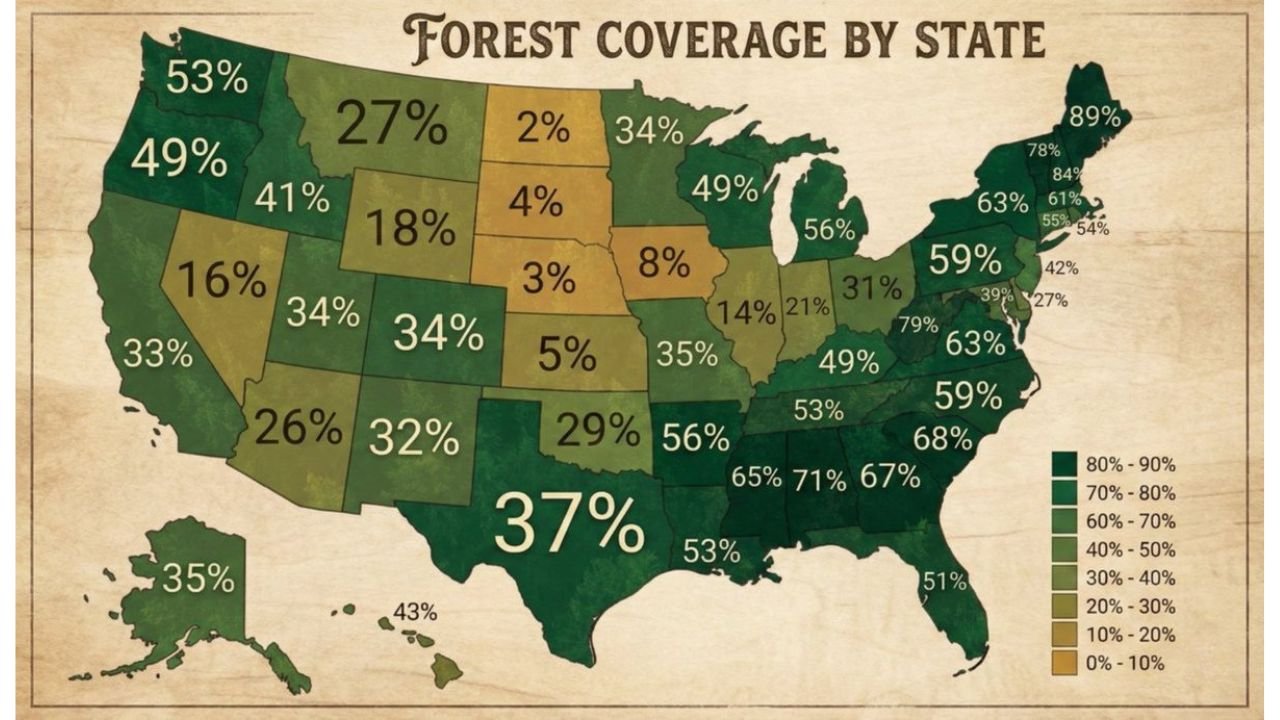
UNITED STATES — A detailed look at forest coverage across the country reveals a sharp divide between heavily wooded regions in the East and Pacific Northwest and the sparsely forested Great Plains, highlighting how geography and climate shape America’s natural landscape.
The latest state-by-state data shows that while some areas are dominated by dense forests, others have almost no tree cover at all — creating one of the most visually striking environmental contrasts nationwide.
Northeast and Appalachians Dominate with Dense Forests
The highest levels of forest coverage are concentrated in the Northeast and Appalachian regions.
- Maine leads the nation with 89% forest coverage
- West Virginia follows with around 79%
- States like New Hampshire (84%) and Vermont (78%) also rank among the most forested
Across this region, thick forests are supported by:
- Consistent rainfall
- Favorable soil conditions
- Long-established ecosystems
Much of this area is covered by continuous woodland, making it one of the greenest parts of the country.
Southeast Emerges as a Forest Powerhouse
The Southeastern United States also stands out with extensive forest coverage.
- Mississippi: 71%
- Alabama: 67%
- Georgia: 65%
- South Carolina: 68%
- North Carolina and Virginia: around 59–63%
These states benefit from:
- Warm climates
- High humidity
- Long growing seasons
Forests here are not only widespread but also play a major role in the timber and paper industries.
Pacific Northwest Maintains Strong Tree Coverage
Out west, the Pacific Northwest continues to be one of the most forest-rich regions.
- Washington: 53%
- Oregon: 49%
- Idaho: 41%
These states are known for dense evergreen forests supported by:
- Heavy rainfall
- Mountainous terrain
- Cooler temperatures
California, while diverse in landscape, shows about 33% forest coverage, reflecting its mix of forests, deserts, and urban areas.
Midwest Shows Mixed Forest Patterns
The Midwest presents a varied picture.
- Wisconsin: 49%
- Michigan: 56%
- Minnesota: 34%
However, as you move further south and west:
- Illinois drops to 14%
- Indiana around 21%
- Ohio about 31%
Agriculture has significantly reduced forest coverage in many of these states, replacing natural landscapes with farmland.
Great Plains Stand Out for Minimal Tree Coverage
The most dramatic contrast appears in the Great Plains, where forest coverage is extremely low.
- North Dakota: just 2%
- South Dakota: 4%
- Nebraska: 3%
- Kansas: 5%
- Iowa: 8%
These states are dominated by open grasslands rather than forests, due to:
- Lower rainfall
- Flat terrain
- Natural prairie ecosystems
This region represents the least forested area in the United States.
Texas and the Southwest Show Moderate Coverage
- Texas sits at about 37%, boosted by forested eastern regions
- Oklahoma: 29%
- Arizona: 26%
- New Mexico: 32%
Forest presence here varies widely depending on elevation and proximity to moisture sources.
Alaska and Hawaii Add Unique Perspectives
- Alaska: 35% forest coverage, despite vast wilderness areas
- Hawaii: around 43%, reflecting tropical forest ecosystems
These states highlight how climate diversity influences forest distribution.
A Nation of Contrasts
This data underscores how dramatically forest coverage changes across the United States:
- Dense forests dominate the East and Northwest
- The Southeast combines high coverage with economic use
- The Plains remain largely treeless
- Transitional zones show mixed patterns
Bottom Line
Forest coverage across the U.S. is shaped by climate, geography, and human activity, creating a patchwork of dense woodlands and open plains.
- The Northeast and Southeast lead in forest density
- The Great Plains remain largely without trees
- The West shows a mix of forested and arid regions
These differences not only define the landscape but also influence weather patterns, wildlife habitats, and regional economies.
Stay with WaldronNews.com for more data-driven insights into how geography and climate continue to shape the United States.