
California, Nevada, Arizona, New Mexico and Western Plains Face Expanding Drought Risk as NOAA Warns Much of the West Could Dry Out Through June 2026
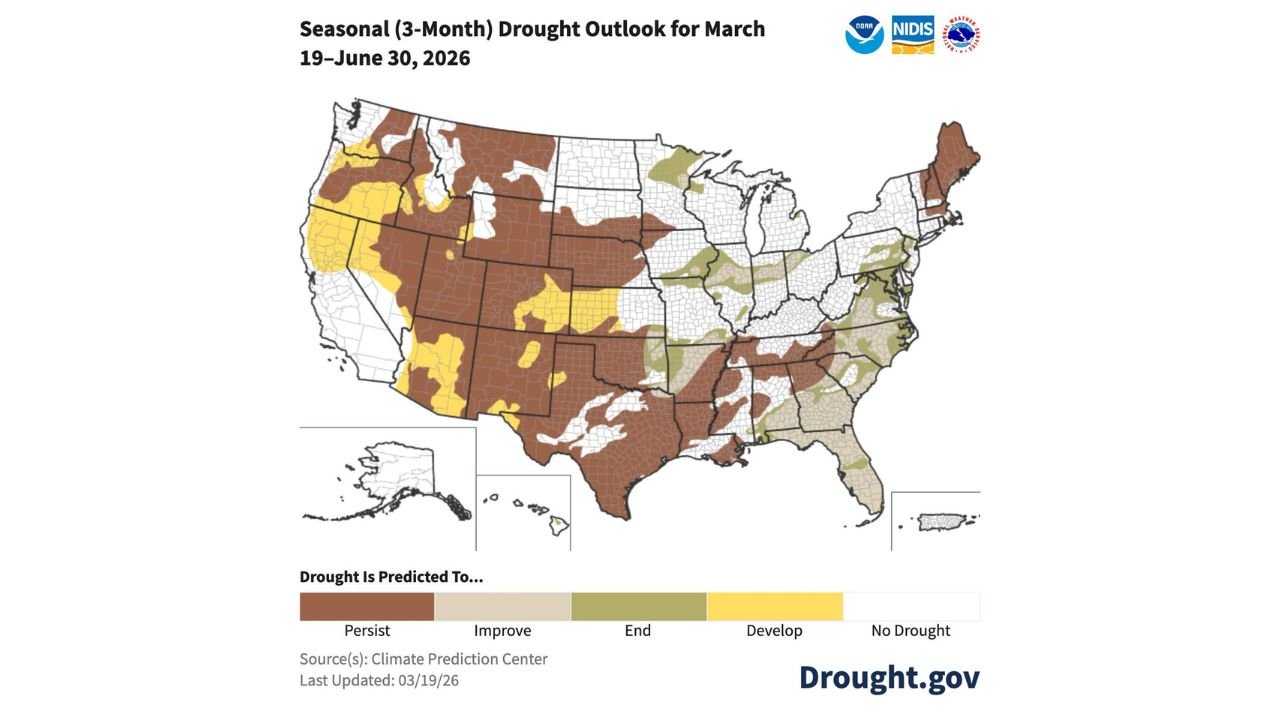
UNITED STATES — A newly released Seasonal (3-Month) Drought Outlook from NOAA’s Climate Prediction Center signals a sharp regional divide heading into late spring and early summer, with widespread drought development expected across the western United States, while parts of the Midwest, Mid-South, East Coast and Hawaii may see improvement.
The outlook, covering March 19 through June 30, 2026, highlights growing dryness concerns in nearly every major western region, including the Northwest, California, Nevada, the Rockies, the Southwest, and portions of the western Plains.
Widespread Drought Development Expected in the West
According to the projection map, drought is forecast to develop or intensify across:
- Washington and Oregon (Northwest)
- California and Nevada
- Idaho, Montana, Wyoming, Utah, and Colorado (Rockies)
- Arizona and New Mexico (Southwest)
- Western Kansas, western Nebraska, and parts of the western Plains
- Portions of Texas and Oklahoma
Large swaths of the Southwest — especially Arizona, New Mexico, southern Nevada, and parts of California’s interior valleys — are shaded for drought development, signaling elevated risk as spring progresses.
Meanwhile, areas already experiencing drought across:
- Texas
- New Mexico
- Southern Colorado
- Western Kansas
- Parts of the northern Rockies
are forecast to see persistence, meaning ongoing dryness with limited relief expected before July.
Midwest, Mid-South and East May See Improvement
In contrast, the outlook shows drought improvement or removal in parts of:
- Missouri and Illinois
- Arkansas and Tennessee
- Kentucky
- Indiana and Ohio
- Portions of the Mid-Atlantic
- Parts of the Southeast
- Hawaii
Green shading across sections of the Midwest and Mid-South indicates improving soil moisture conditions, likely aided by recent storm systems and increased precipitation earlier this month.
Portions of the Great Lakes region and Ohio Valley are also forecast to see drought conditions ease or end during the three-month period.
Texas Split Between Persistence and Development
Texas appears divided in the outlook.
- Central and southern Texas show continued drought persistence.
- Western Texas shows ongoing dryness.
- Some neighboring Plains areas may see new development.
This suggests that while parts of the state may stabilize, meaningful widespread improvement is not currently expected statewide.
What This Means for Spring and Early Summer
The forecast period covers a crucial agricultural window and the transition into peak wildfire season across the West.
If drought expands as projected:
- Wildfire risk could increase across California, Nevada, Arizona, and New Mexico.
- Snowpack-dependent regions in the Rockies may face reduced runoff.
- Water resource management challenges could intensify in desert and interior West communities.
Meanwhile, improving moisture across the Midwest and Mid-South may support crop development and reduce fire risk in those regions.
Hawaii and the East See Positive Signals
The outlook also calls for improvement across much of Hawaii and sections of the Eastern U.S., a notable contrast to the expected drying trend out West.
While not every location is forecast to shift dramatically, the overall pattern suggests a wet-leaning East and drying West heading into summer.
Looking Ahead
Seasonal drought outlooks are based on large-scale climate signals, soil moisture trends, and precipitation forecasts. Adjustments are possible as spring weather evolves.
However, as of mid-March, forecasters are confident that:
- The West faces growing dryness risk.
- The Midwest and Mid-South are trending wetter.
- Existing drought areas in parts of Texas and the Southwest are unlikely to see rapid relief.
Stay with WaldronNews.com for continued coverage as spring rainfall patterns and summer heat trends take shape across the United States.