
Arizona, Nevada, New Mexico and West Texas Plunge Into Single-Digit Humidity as “It’s a Dry Heat” Turns Extreme Across the Southwest
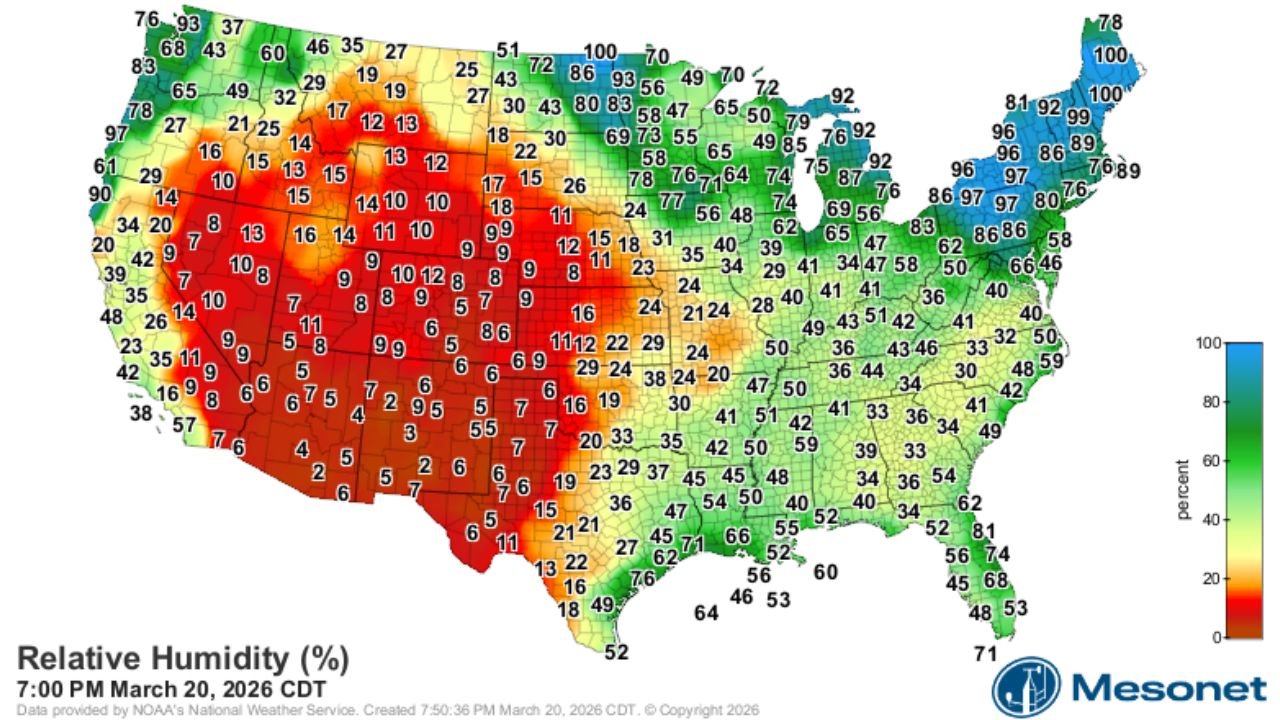
PHOENIX, AZ — If the air across the Southwest felt unusually dry Friday evening, the data confirms it — vast portions of Arizona, Nevada, New Mexico, Utah and West Texas dropped into single-digit relative humidity levels.
Observations at 7:00 PM CDT on March 20 show widespread humidity values between 2% and 10% across the Desert Southwest, creating textbook “dry heat” conditions — but at levels that can rapidly elevate fire danger.
Single-Digit Humidity Dominates the Southwest
The most extreme readings were concentrated across:
- Southern and central Arizona
- Southern Nevada
- Much of New Mexico
- Far West Texas
- Southern Utah
Several stations reported humidity as low as 2% to 6%, especially across southern Arizona and parts of West Texas. Large areas of New Mexico and Nevada hovered between 5% and 10%.
These values are exceptionally low and indicate extremely dry air near the surface.
Sharp Contrast Across the United States
While the Southwest baked in ultra-dry air, the rest of the country painted a dramatically different picture:
- The Southeast, including Louisiana, Mississippi, Alabama, Georgia and Florida, reported humidity values generally between 45% and 70%.
- The Midwest, including Illinois, Indiana, Ohio and Michigan, ranged from 40% to 70%.
- The Northeast, including New York and New England, showed readings between 70% and near 100% in some areas.
This sharp gradient highlights a major atmospheric divide between dry western air masses and more moisture-rich eastern conditions.
Why Humidity Matters
Relative humidity below 15% is typically considered critical in fire weather forecasting. When values fall into the single digits:
- Vegetation dries rapidly
- Fire ignition becomes easier
- Fires can spread quickly under windy conditions
- Outdoor activities involving sparks or open flames become more hazardous
Even in the absence of extreme wind, prolonged low humidity can elevate wildfire risk significantly.
“It’s a Dry Heat” — But There’s a Trade-Off
The phrase “it’s a dry heat” is commonly used across Arizona and Nevada to describe summer temperatures. However, extremely low humidity also means:
- Increased dehydration risk
- Dry skin and respiratory irritation
- Elevated static electricity
- Greater fire sensitivity
The evening humidity map suggests a classic pre-summer pattern taking hold early, with desert air firmly entrenched across the interior Southwest.
West Texas and New Mexico Particularly Dry
Areas near:
- El Paso, TX
- Southern New Mexico
- Central and southern Arizona
showed some of the lowest humidity values on the map, reinforcing ongoing concerns during the spring transition season.
Looking Ahead
As temperatures continue to warm heading deeper into spring, persistent dry air masses could keep relative humidity suppressed across the Southwest.
Residents across Arizona, Nevada, New Mexico and West Texas are encouraged to remain mindful of fire safety and hydration, especially during peak afternoon hours when humidity typically drops even further.
Stay with WaldronNews.com for continuing national weather coverage and fire weather updates.