
Wisconsin, Michigan, Indiana and Ohio Face Frost and Freeze Risk May 1 Through 3 as Temperatures Threaten to Drop Below 32 Degrees After Rain Clears
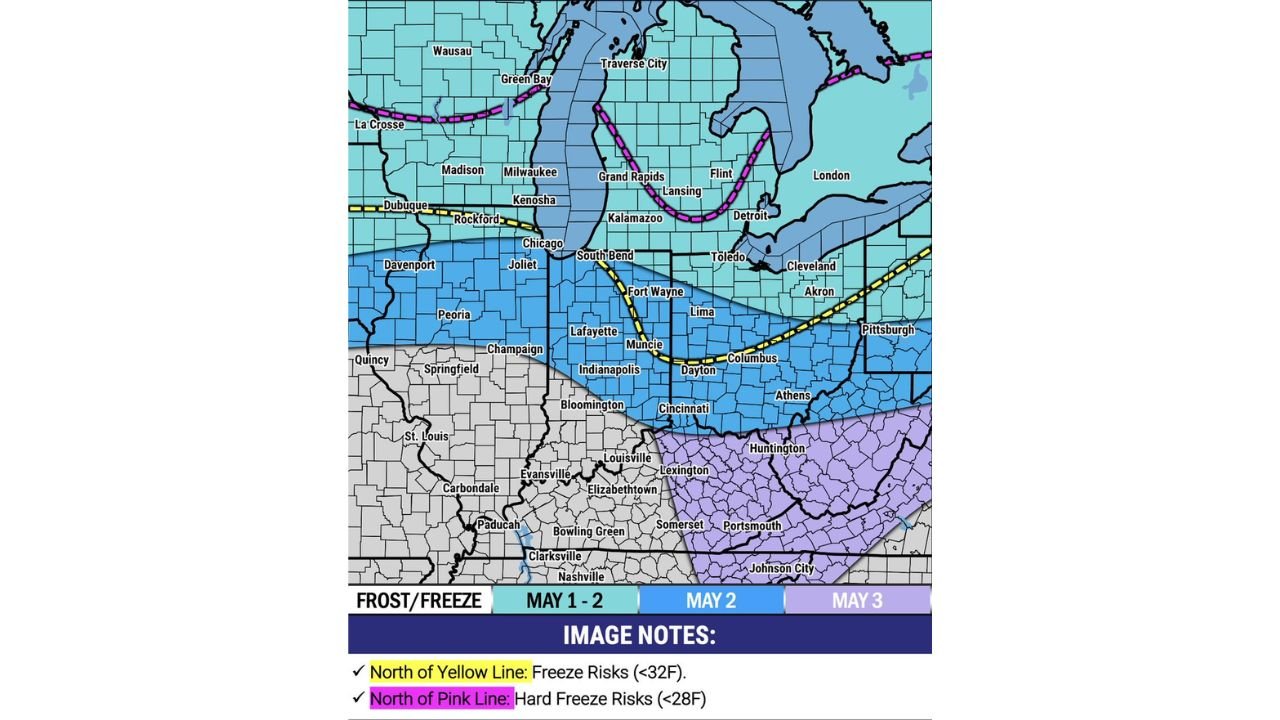
INDIANAPOLIS, Indiana — Just as persistent rain chances wind down later this week, a swift and damaging cold shot is set to follow immediately behind the clearing skies — bringing frost and freeze risks from May 1 through May 3 across a wide swath of the Midwest including Wisconsin, Michigan, Indiana, Ohio, Kentucky, and Illinois. For anyone on the fence about spring planting, this three-day window is the reason to wait. Temperatures dropping below 32 degrees Fahrenheit will be widespread, and a harder freeze below 28 degrees is forecast for portions of Wisconsin and Michigan — cold enough to kill established plants, not just damage tender seedlings.
Every City at Risk From May 1 Through May 3 and How Bad It Gets
The map draws two critical lines that determine who faces what level of danger.
North of the yellow line — temperatures below 32 degrees Fahrenheit. This is a standard freeze. Anything in the ground that is not cold-hardy is at serious risk.
North of the pink line — temperatures below 28 degrees Fahrenheit. This is a hard freeze. At 28 degrees, even established perennials, fruit tree blossoms, and cold-tolerant plants face significant damage or death.
| City | State | Freeze Risk | Hard Freeze Risk | Days Affected |
|---|---|---|---|---|
| Wausau | Wisconsin | Yes — below 32F | Yes — below 28F | May 1, 2, 3 |
| Green Bay | Wisconsin | Yes — below 32F | Yes — below 28F | May 1, 2, 3 |
| Traverse City | Michigan | Yes — below 32F | Yes — below 28F | May 1, 2, 3 |
| La Crosse | Wisconsin | Yes — below 32F | Possible | May 1, 2 |
| Madison | Wisconsin | Yes — below 32F | Possible | May 1, 2 |
| Grand Rapids | Michigan | Yes — below 32F | Possible | May 1, 2 |
| Flint | Michigan | Yes — below 32F | Possible | May 1, 2 |
| Detroit | Michigan | Yes — below 32F | Borderline | May 2 |
| Chicago | Illinois | Yes — below 32F | No | May 1, 2 |
| South Bend | Indiana | Yes — below 32F | No | May 1, 2 |
| Fort Wayne | Indiana | Yes — below 32F | No | May 1, 2 |
| Indianapolis | Indiana | Frost risk | No | May 1, 2 |
| Toledo | Ohio | Yes — below 32F | No | May 2 |
| Columbus | Ohio | Frost risk | No | May 2 |
| Cleveland | Ohio | Frost risk | No | May 2, 3 |
| Pittsburgh | Pennsylvania | Frost risk | No | May 3 |
| Louisville | Kentucky | Frost risk | No | May 1, 2 |
| Lexington | Kentucky | Frost risk | No | May 1, 2 |
| Nashville | Tennessee | Frost risk — southern edge | No | May 1 |
Why Freeze Risk in May Is More Dangerous Than Freeze Risk in March
A hard freeze in March is expected. Plants have not yet broken dormancy, buds have not opened, and the ground has not been worked. A freeze in early May is a completely different threat — and in many ways a more damaging one.
| Why May Freezes Hit Harder | Detail |
|---|---|
| Plants are actively growing | Tender new growth has no cold tolerance |
| Fruit tree blossoms are open | A single night below 28F destroys the entire fruit crop for the season |
| Gardens are often already planted | Tomatoes, peppers, cucumbers — all die at 32F |
| Soil is warm | Warm soil creates a false sense of security — air temperature is what kills plants |
| Days are longer and sunnier | Plants push growth harder in May, making new growth even more vulnerable |
Traverse City, Michigan is a particularly telling example here. The area is known for its cherry orchards — and cherry blossoms at this stage of May are fully open and devastatingly vulnerable to temperatures below 28 degrees Fahrenheit. A hard freeze forecast for that region during blossom period is not a minor weather note. It is a direct agricultural emergency for growers.
How Three Days of Frost and Freeze Play Out Across the Midwest
This is not a single cold night. It is a three-day event structured in layers.
May 1 and 2 carry the broadest freeze coverage. The yellow freeze line drops as far south as Indianapolis, Louisville, and the Ohio River valley, meaning the cold air mass is substantial and widespread. Wisconsin and Michigan are inside the hard freeze zone both nights.
May 2 represents the most dangerous overlap point — the cold air is fully settled across the region and temperatures have had two consecutive nights to drop without meaningful recovery during the day. This is when cumulative plant damage accelerates even if individual nights do not reach record lows.
May 3 begins the retreat, with the freeze zone pulling northward and coverage shrinking. Pittsburgh and Cleveland catch the trailing edge of the cold while states to the south begin warming. Wisconsin and the Upper Midwest remain in the hard freeze zone through May 3 before temperatures moderate.
🌡️ Quick Reference — What Each Temperature Means for Your Garden
| Temperature | What Happens to Plants |
|---|---|
| 36 to 32F | Frost forms on surfaces — tender annuals and seedlings damaged |
| 32F | Ice crystals form in plant tissue — most vegetables and annuals die |
| 28F | Hard freeze — established perennials, shrubs, and fruit blossoms killed |
| Below 28F | Severe hard freeze — even cold-tolerant plants face serious damage |
What Wisconsin, Michigan, Indiana and Ohio Residents Should Do Before May 1
- Do not plant warm-season vegetables — tomatoes, peppers, squash, cucumbers, beans — until after May 3 at the earliest across Indiana, Ohio, and Illinois; wait until May 5 or later for Wisconsin and Michigan
- Cover established garden beds with frost cloth, old sheets, or burlap before sunset on April 30 — covering plants traps ground heat and can keep temperatures several degrees warmer underneath
- Fruit growers in Michigan and Wisconsin face the most urgent situation — orchard operators should activate frost protection measures including wind machines and overhead irrigation if available, as temperatures below 28 degrees during bloom will cause direct crop loss
- Potted plants must come indoors — container plants have no soil insulation and freeze faster than in-ground plants; bring every pot inside before nightfall April 30
- Indianapolis and Columbus residents sit just south of the hardest freeze zone but are not safe — frost is still forecast and overnight temperatures near 32 degrees are enough to damage plants left unprotected
- Monitor each night separately — May 1, May 2, and May 3 each carry independent risk; a plant that survives May 1 unprotected can still be killed on May 2 if overnight lows drop further
WaldronNews.com will continue tracking the May 1 through 3 frost and freeze risk across the Midwest and provide updates as overnight temperature forecasts are refined heading into the weekend.