
El Nino Is Returning for the 2026 Hurricane Season and While It Should Reduce Storm Activity History Shows Major Hurricanes Can Still Strike the Gulf Coast and Atlantic
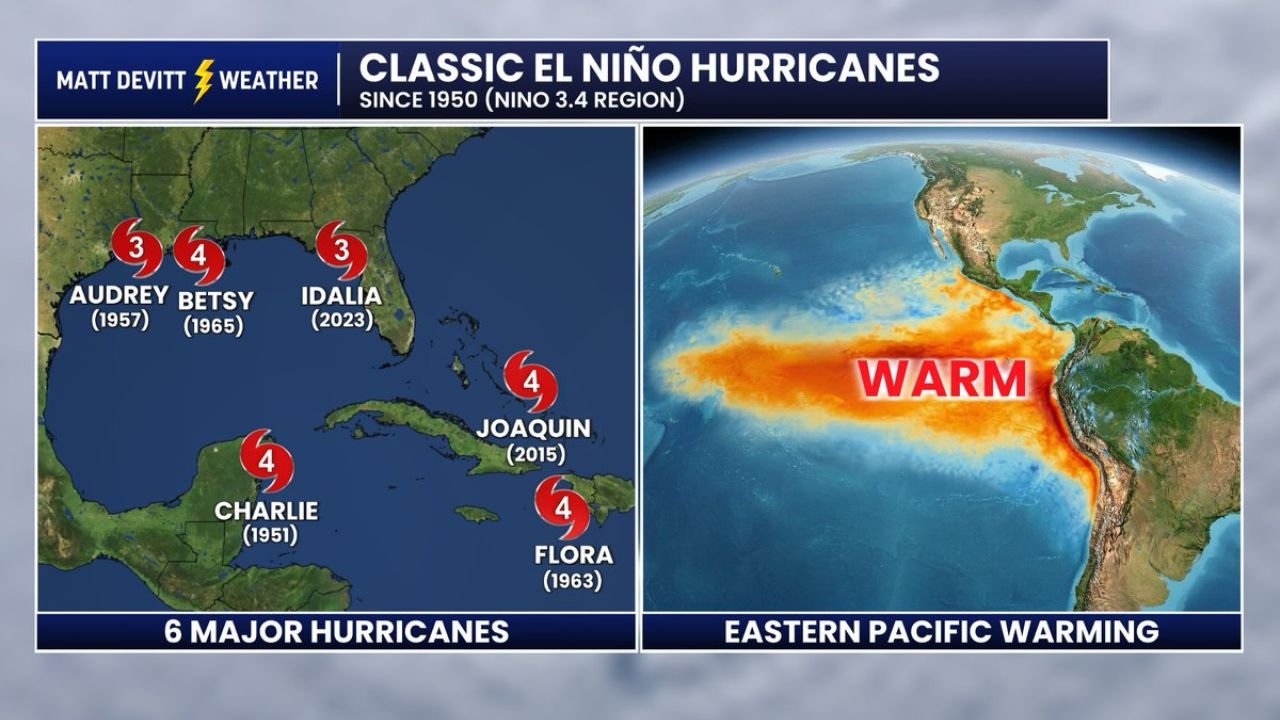
MIAMI, Florida — A strong El Niño pattern is building ahead of the 2026 Atlantic hurricane season — and while that is generally welcome news for coastal communities from Texas and Louisiana through Florida and up the Atlantic seaboard, history delivers an important and sobering warning that should not be overlooked: major hurricanes can and do still develop during El Niño years, and some of the most destructive storms on record since 1950 have formed during classic El Niño conditions.
El Niño — characterized by warming sea surface temperatures across the Eastern Pacific Ocean — historically suppresses Atlantic hurricane activity by increasing upper-level wind shear across the basin, which disrupts the atmospheric organization that tropical storms need to intensify into major hurricanes. In most El Niño years, the overall number of named storms, hurricanes, and major hurricanes drops measurably compared to neutral or La Niña seasons.
But most is not all — and the historical record makes that distinction critically important for Gulf Coast and Atlantic coastal residents heading into the 2026 season.
Six Major Hurricanes That Prove El Niño Is Not a Shield
The historical record of major hurricanes since 1950 during classic El Niño years documents six significant storms that defied the suppression pattern and struck with devastating force — proof that no hurricane season, regardless of El Niño strength, can be dismissed as safe:
Hurricane Audrey — Category 3 — 1957: One of the deadliest hurricanes in Louisiana history, Audrey made landfall along the Louisiana Gulf Coast during a classic El Niño year and produced catastrophic storm surge and flooding across coastal communities. Audrey killed over 400 people — a reminder that even El Niño-era storms can be catastrophic when the right individual setup comes together.
Hurricane Betsy — Category 4 — 1965: Betsy struck Louisiana and the Gulf Coast as a powerful Category 4 hurricane during an El Niño year, causing catastrophic flooding across New Orleans and the surrounding region. Betsy was one of the first hurricanes to cause over one billion dollars in damage and remains one of the most significant Gulf Coast hurricane disasters of the 20th century.
Hurricane Charlie — Category 4 — 1951: A powerful Category 4 storm during a classic El Niño year — demonstrating that the Gulf of Mexico and Caribbean can still produce violent major hurricanes even when the broader Atlantic pattern is suppressed.
Hurricane Flora — Category 4 — 1963: Flora struck during an El Niño year and caused catastrophic destruction across the Caribbean — one of the deadliest Atlantic hurricanes of the 20th century, killing thousands across Haiti and Cuba during a season that El Niño was supposed to be suppressing tropical activity.
Hurricane Joaquin — Category 4 — 2015: Perhaps the most recent and vivid reminder of El Niño’s limits, Joaquin explosively intensified to a powerful Category 4 hurricane in 2015 — a year with one of the strongest El Niño events on record — and caused catastrophic destruction across the Bahamas while threatening the United States East Coast. The same El Niño year that suppressed overall Atlantic activity still produced one of the most powerful hurricanes of the decade.
Hurricane Idalia — Category 3 — 2023: The most recent entry on this list — Idalia made landfall along the Florida Gulf Coast as a Category 3 hurricane in 2023 during El Niño conditions, striking Big Bend region communities that had not seen a major hurricane landfall in over a century. Idalia proved that El Niño suppression does not protect any specific coastline from a determined individual storm.
What the Eastern Pacific Warming Means for 2026
The Eastern Pacific warming pattern already established and expanding across the tropical Pacific heading into 2026 is the physical mechanism driving El Niño’s influence on Atlantic hurricane activity. The warm water anomaly — shown in the striking orange and red coloring across the Eastern Pacific in the satellite imagery — is what generates the increased upper-level wind shear across the Atlantic basin that disrupts storm development.
The stronger this Eastern Pacific warming becomes, the more suppressive its influence on the Atlantic hurricane season. A strong El Niño heading into 2026 would represent genuinely good news for overall hurricane season activity — but as the six historical examples above demonstrate, it cannot eliminate the threat of individual major hurricane development when the right atmospheric setup comes together in the right location at the right time.
Why Gulf Coast and Atlantic Residents Cannot Relax
The critical message from the historical record is one that every coastal resident from Brownsville, Texas through Key West, Florida and up through the Carolinas, Virginia, and New England needs to internalize before the 2026 hurricane season begins:
El Niño reduces the odds — it does not eliminate the threat.
A season with fewer named storms still only needs one Joaquin, one Betsy, or one Idalia to make landfall in a populated area to cause billions in damage and claim lives. The 2015 season — one of the strongest El Niño years on record — still produced a Category 4 hurricane that devastated the Bahamas. The 1965 season produced a Category 4 that flooded New Orleans.
For residents across Louisiana, Texas, Florida, and the Atlantic Coast, the preparation requirements for the 2026 hurricane season remain exactly the same as any other year:
What Coastal Residents Must Do Before Hurricane Season Begins June 1
- Do not interpret El Niño as permission to skip hurricane preparedness — the six historical storms documented above all occurred during El Niño years when the same logic might have suggested reduced risk
- Review and update your hurricane evacuation plan now — before any storm is named or threatening, identify your evacuation routes and destination
- Hurricane supply kits should be assembled or refreshed before June 1 — water, food, medications, documents, and emergency supplies for at least 72 hours
- Florida Gulf Coast residents — Idalia’s 2023 landfall during El Niño in the Big Bend region showed that even historically less-active coastlines are not immune during suppressed seasons
- Louisiana and Texas Gulf Coast communities — Audrey and Betsy both struck the Gulf Coast during El Niño years. Do not assume El Niño protects your specific coastline
- Monitor the Atlantic hurricane season throughout the June through November window — individual storm development can happen rapidly regardless of overall seasonal suppression
- Home insurance and flood insurance should be reviewed and updated before hurricane season — El Niño does not cover the cost of an uninsured storm surge loss
El Niño returning for 2026 is welcome news — but it is not a guarantee of safety for any community along the Gulf Coast or Atlantic seaboard. History has proven six times since 1950 that major hurricanes find a way through even the most suppressed El Niño seasons, and the 2026 season deserves the same level of respect and preparation as any other.
WaldronNews.com will continue tracking El Niño development and the 2026 Atlantic hurricane season outlook and will provide updates as seasonal forecasts are refined and the June 1 start of hurricane season approaches.