
Mississippi and Alabama Are the Most Dangerous Places on Earth for Tornadoes With Higher Kill Rates Than Anywhere Else in the World Including Tornado Alley
JACKSON, Mississippi — You are more likely to be hit or killed by a tornado in Mississippi and Alabama than anywhere else on Earth. That is not a dramatic claim — it is what 68 years of tornado path data from 1950 to 2018 shows when averaged by total path damage per year per unit area. The Deep South, not the Oklahoma and Kansas plains, holds the highest concentration of deadly tornado exposure on the planet.
What the Data Actually Shows
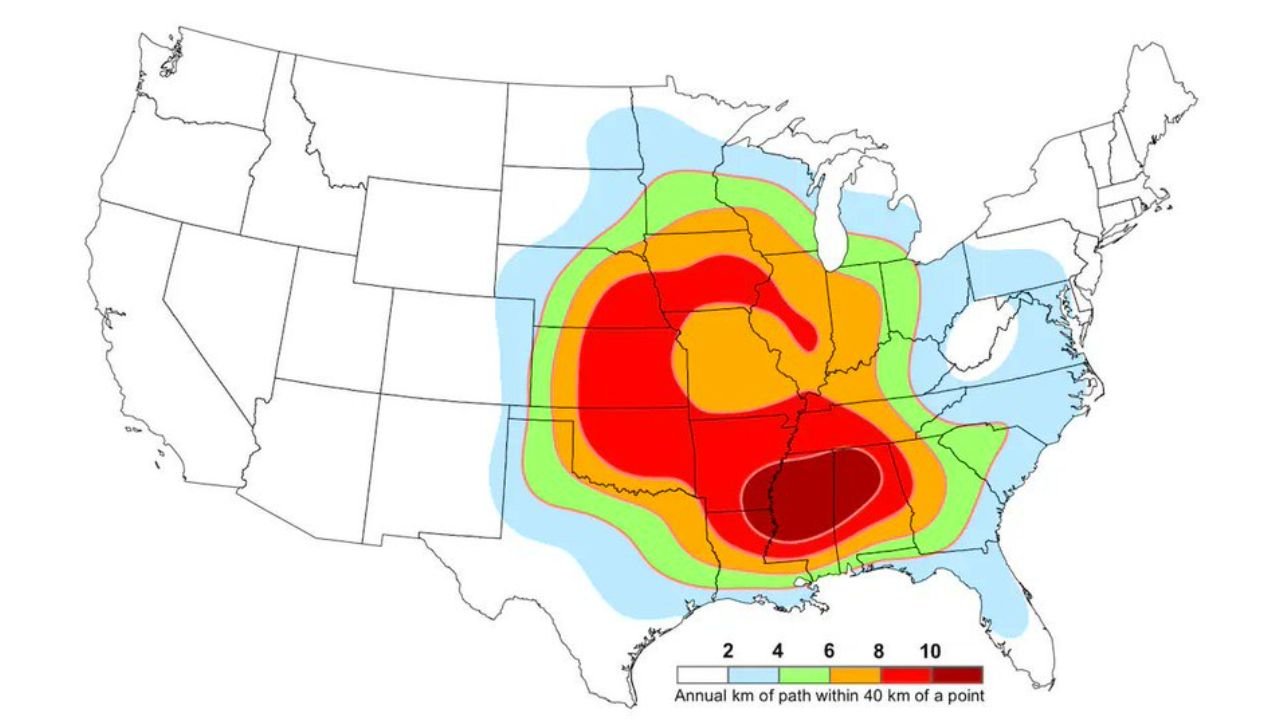
The Grady Dixon plot averaging annual kilometers of tornado path within 40 kilometers of a point reveals the following zones across the United States:
- Darkest red core — over 10 annual km of path: Centered directly over southern Mississippi and Alabama — the single most tornado-path-dense location on Earth by this measurement
- Bright red zone — 8 to 10 annual km: Extending across central Mississippi, central Alabama, western Tennessee and eastern Arkansas
- Orange zone — 6 to 8 annual km: Covering Oklahoma, Kansas, Missouri, Illinois and the broader Mid-South corridor
- Yellow-green zone — 4 to 6 annual km: Reaching across Nebraska, Iowa, Indiana, Ohio and the Tennessee Valley
- Light green zone — 2 to 4 annual km: Covering most of the central and southern United States from the Dakotas to the Carolinas
The conventional Tornado Alley of Oklahoma and Kansas sits firmly in the orange zone — dangerous, but not as dangerous as southern Mississippi and Alabama where the darkest concentration of tornado path exposure on Earth is centered.
Why Mississippi and Alabama Are More Dangerous Than Tornado Alley
- Longer average tornado tracks — tornadoes in the Deep South travel further on the ground, covering more communities per storm than Plains tornadoes
- Higher population density along tornado paths — rural communities, mobile home concentrations and older housing stock sit directly in the highest-risk corridor
- Nighttime tornado frequency — Deep South tornadoes occur more often at night when residents are asleep, reducing warning response time dramatically
- Rain-wrapped and invisible storms — unlike the open Plains where tornadoes are often visible from miles away, southern Mississippi and Alabama tornadoes frequently arrive inside heavy rain with no visual warning
- Tree cover and terrain obscure both visual detection by residents and damage path identification by surveyors after the fact
- Lower public awareness — decades of Tornado Alley media focus have left Deep South residents less psychologically prepared for the tornado threat in their own backyards
What Wednesday Night’s Franklin County EF4 Confirms
The preliminary EF4 tornado through Franklin County with its long track from Darrington through Meadville, the violent rotation signatures over Brookhaven and the active PDS tornado warning for Lincoln County on Wednesday May 6, 2026 are not surprising events for this geography. They are exactly what the 68-year dataset predicts will happen repeatedly in the darkest zone on this map. Southern Mississippi is not experiencing unusual tornado activity — it is experiencing what it statistically experiences more than anywhere else on Earth.
What Residents of Mississippi and Alabama Must Understand
- Your tornado risk is higher than residents of Oklahoma City and Wichita — the data is unambiguous on this point and has been since records began in 1950
- A NOAA weather radio with battery backup is non-negotiable in this region — nighttime tornadoes kill people who never received a warning they could act on
- Mobile homes must be evacuated when any tornado watch is issued for your county — the darkest zone on this map is not a place to shelter in a manufactured structure
- Know your county’s outdoor warning siren locations and understand that sirens are designed for people who are already outside — they are not reliable indoor warning systems
- Discuss your family tornado plan before storm season — the time to decide where you will shelter is not when a PDS tornado warning is active over your neighborhood
WaldronNews.com will continue tracking tornado threats and severe weather patterns across Mississippi and Alabama and will provide updates as the active weather pattern continues through the coming weeks.