
Pennsylvania Sits at the Heart of a Major East–West Divide in U.S. Tree Diversity, New National Map Shows
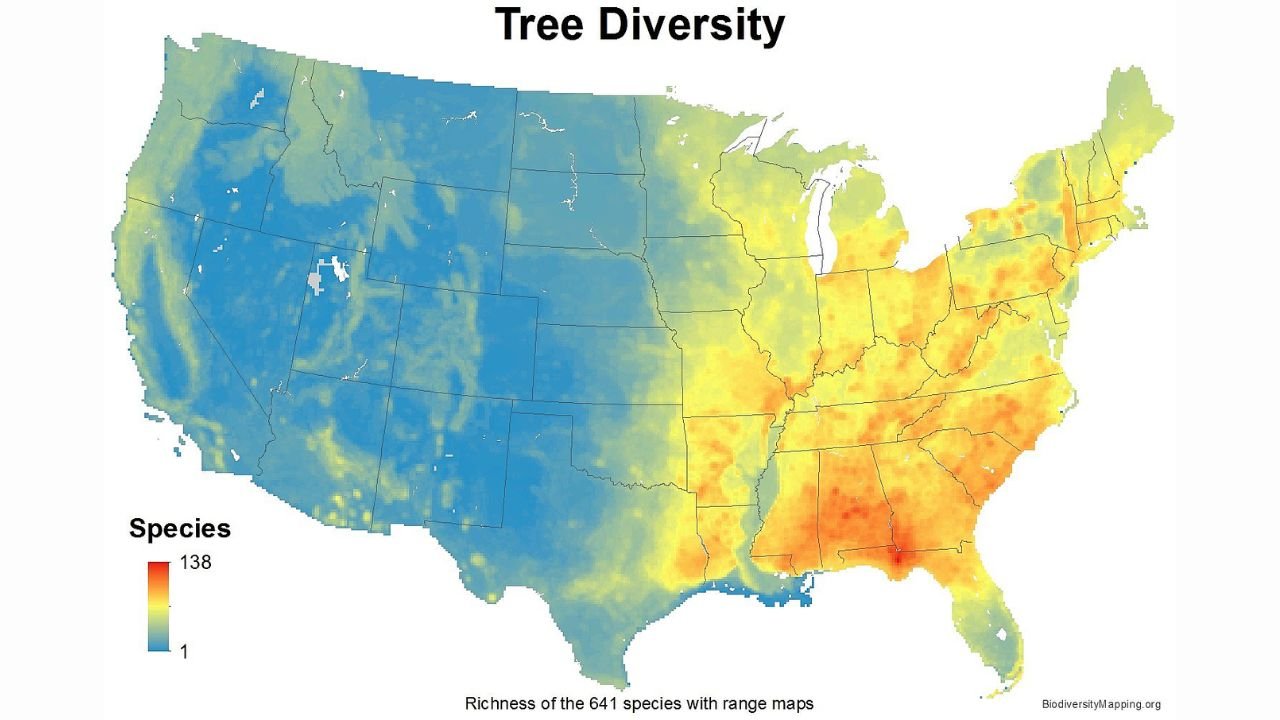
PENNSYLVANIA — A newly released national biodiversity map highlights a striking divide in tree species richness across the United States, revealing that Pennsylvania and much of the eastern half of the country rank dramatically higher in tree diversity compared to the West. The analysis, based on range maps of 641 tree species, shows that portions of the Southeast and Mid-Atlantic contain some of the densest concentrations of tree species anywhere in the nation.
Pennsylvania falls directly within this corridor of elevated biodiversity, displaying significantly higher species richness than states in the Great Plains, Rockies, and West Coast.
East Dominates U.S. Tree Species Richness
The map shows a sharp gradient from west to east:
- Western U.S. (blue shading): Low species richness, often fewer than 20–40 species in large regions.
- Central U.S. (green shading): Moderate richness, gradually increasing toward the Mississippi River.
- Eastern U.S. (yellow to red shading): High to extremely high diversity, with some areas hosting over 130 tree species.
The Southeast — especially northern Florida, Georgia, and Alabama — contains the highest concentrations of tree species in the entire country.
Pennsylvania’s location places it within the broader Appalachian biodiversity belt, contributing to its rich native forest ecosystems.
Pennsylvania’s Tree Diversity: Higher Than Most of the Nation
While not at the extreme high end of the national spectrum, Pennsylvania shows consistently elevated levels of tree diversity, far outpacing the Midwest, Great Plains, and all western states.
The map highlights:
- Stronger diversity in southern and eastern Pennsylvania
- Moderate-to-high richness in the Appalachian and central regions
- Gradual transitions toward very high biodiversity as one moves into the Mid-Atlantic and Southeastern states
The state’s mix of deciduous hardwoods, forested ridges, river valleys, and varied climate zones supports a broad range of species — including oaks, maples, hickories, birches, pines, and hemlocks.
Why the Eastern U.S. Has So Many More Tree Species
Scientists explain that the East’s dominance in tree diversity stems from several factors:
1. Climate Stability Over Geological Time
During past ice ages, the Appalachian Mountains and southeastern U.S. provided a refuge where species survived. After glaciers retreated, these forests expanded again — preserving diversity over tens of thousands of years.
2. Higher Rainfall and Humidity
Eastern states receive more annual precipitation, supporting a wider range of forests and specialized ecosystems.
3. Fewer Natural Barriers
The relatively low elevation and broad forest belts of the East allow species to spread more easily than in the mountain-locked western states.
4. Soil Variety
Pennsylvania’s mix of limestone valleys, shale ridges, and river floodplains creates numerous habitats that support different species.
The West: Large Landscapes, Low Tree Diversity
In contrast, the Western U.S. shows extensive areas of low diversity, especially across:
- Nevada
- Utah
- Wyoming
- Montana
- Arizona and New Mexico
- Eastern Oregon and Washington
These regions contain vast deserts, high plateaus, and mountain ranges — landscapes where conditions limit the number of species that can survive.
Pennsylvania’s Forest Legacy Remains a Key Environmental Asset
Despite development pressures, Pennsylvania remains one of the most heavily forested states in the Northeast. Its stronger-than-average tree diversity:
- Supports wildlife populations
- Strengthens ecological resilience
- Enhances carbon storage and air quality
- Contributes to regional climate stability
Forestry experts note that maintaining species diversity will be essential as the state faces challenges from climate change, invasive species, and shifting precipitation patterns.
A Clear Picture of America’s Biodiversity Divide
The tree diversity map provides one of the clearest visualizations yet of the United States’ ecological contrast:
- The West: Beautiful but species-limited.
- The East: A forest biodiversity powerhouse.
- Pennsylvania: A critical link between the Mid-Atlantic and Appalachian diversity zones.
With over half the country showing relatively low diversity, Pennsylvania’s forests play an increasingly important role in preserving the nation’s ecological richness.
WaldronNews.com will continue to cover environmental science, regional biodiversity, and conservation developments across Pennsylvania and the eastern United States.