
Ada, Durant and Hugo Face Several Tornadoes Including EF2 Potential Saturday as Two Surface Boundaries Feed Extra Spin Into Southeast Oklahoma Storms
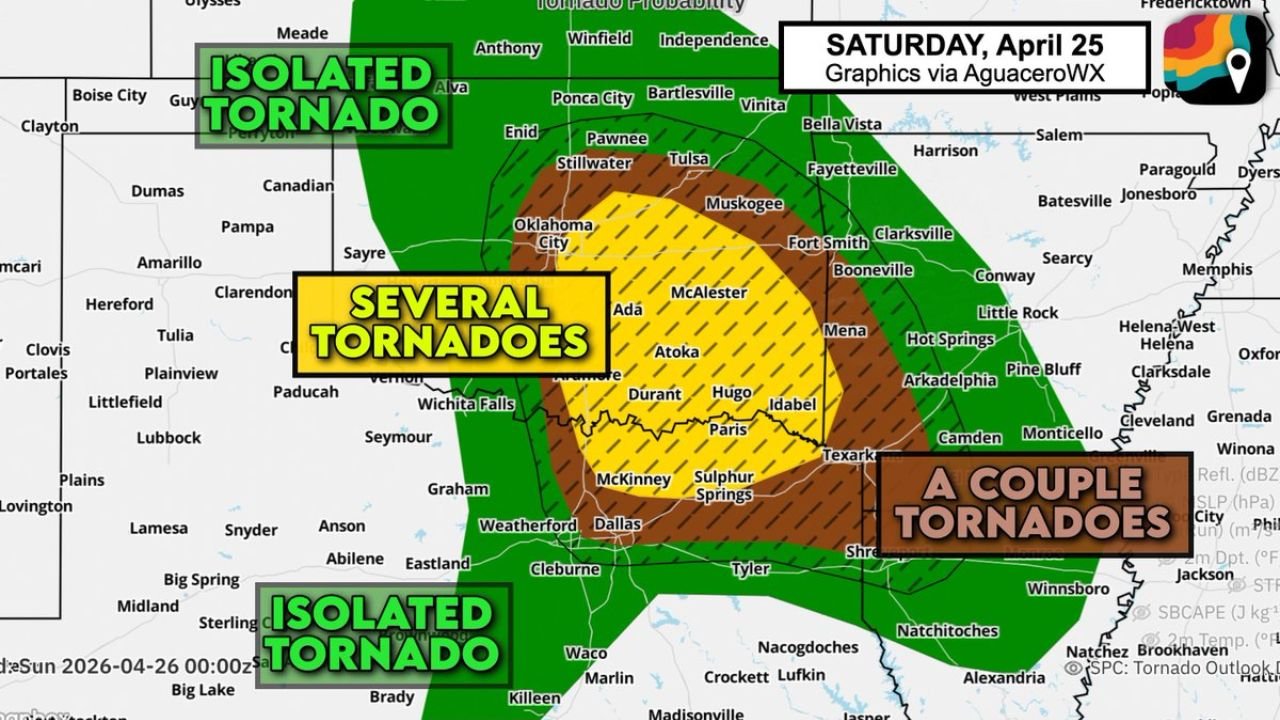
ADA, Oklahoma — The tornado probability map for Saturday, April 25 puts Ada, Atoka, Durant, Hugo, and the surrounding southeast Oklahoma corridor in the most dangerous zone on the entire map. The yellow Several Tornadoes zone covers this region, meaning multiple tornadoes are expected rather than just a possibility. An isolated EF2 or stronger tornado is specifically possible today, and two subtle surface boundaries tracking across Oklahoma and north Texas are the atmospheric feature that could push individual storms into significantly more robust rotation than they would otherwise achieve.
The map tells the full geographic story clearly across four distinct zones.
What Each Zone Means for Each City
The yellow Several Tornadoes zone is the highest-probability tornado corridor today and covers a concentrated area centered over Ada, McAlester, Atoka, Durant, Hugo, and Paris, Texas. Several tornadoes are expected from this zone, and at least one of them has the potential to reach EF2 intensity given the boundary interaction dynamics described below. Communities in Pontotoc, Coal, Atoka, Bryan, Choctaw, and McCurtain counties in Oklahoma and Lamar County in Texas are all inside this yellow core.
The brown hatched A Couple Tornadoes zone surrounds the yellow core and extends the tornado threat with slightly lower probability outward through Muskogee, Fort Smith, Texarkana, and the Arkansas-Oklahoma border region. A couple of tornadoes are expected here, meaning the threat is real but less concentrated than the southeast Oklahoma core.
The dark green Several Tornadoes outer ring extends the broader tornado possibility further, covering Tulsa, Oklahoma City, Fayetteville, Jonesboro, and into the Memphis fringe. A tornado is possible anywhere in this zone from isolated supercells.
The light green Isolated Tornado zones mark the outer edges of the probability map, covering western Oklahoma, western Kansas, and south Texas including the Dallas-Fort Worth fringe. A single isolated tornado is possible in these zones but confidence is lower and coverage is limited.
The Two Boundaries That Change Everything
The most important meteorological detail in today’s forecast is the presence of two subtle surface boundaries across Oklahoma and north Texas where winds at the surface are shifting direction slightly. These boundaries are invisible on standard weather maps but forecasters tracking surface observations can identify them through the telltale wind shift signatures.
When a supercell encounters one of these boundaries, something specific happens. The boundary itself contains concentrated horizontal vorticity spinning along the surface, generated by the wind shift. When a storm’s updraft ingests that pre-existing spin from the boundary, it amplifies the storm’s own internal rotation substantially. The result is a storm that spins more robustly and produces tornadoes more efficiently than it would in the open environment away from the boundary.
Both boundaries today are positioned across the yellow and brown tornado probability zones in southeast Oklahoma and northeast Texas. Any supercell that develops in this area and tracks along or crosses these boundaries will have access to the extra rotational energy they provide. That is the specific mechanism behind the EF2 or stronger tornado possibility today.
Why Southeast Oklahoma is the Bull’s-Eye
Ada and the surrounding communities sit at the convergence of the highest instability values, the best wind shear orientation, and the boundary positions that provide extra low-level spin. The yellow Several Tornadoes designation is not assigned lightly. It means the probability of multiple tornadoes from this region is higher than anywhere else on the map today, and the atmospheric ingredients supporting that probability are all verified and in place.
Durant and Hugo near the Red River are in an especially exposed position because supercells tracking from the northwest can travel across flat terrain from Ada southeastward with minimal weakening, maintaining their structure through the heart of the Several Tornadoes zone for extended periods.
Paris, Texas just across the state line is inside the yellow zone, meaning northeast Texas communities face the same threat level as southeast Oklahoma communities during today’s supercell phase.
North Texas Outside the Core Zone
Dallas-Fort Worth sits in the outer green Isolated Tornado zone rather than the higher probability inner zones. That distinction matters because the DFW metro often draws significant attention during Oklahoma severe weather events as people wonder about their own exposure. Today, the tornado threat for Dallas is real but isolated. The primary severe weather threat for the DFW corridor today is large hail from supercells that track through the region, with tornadoes possible but not the dominant expected outcome as they are further north in southeast Oklahoma.
The Window That Matters Most
Based on the earlier forecast discussion, the highest tornado probability within the yellow zone runs from approximately 5 to 8 PM while supercells remain discrete before merging into a larger line. Any community in the yellow or brown zones that has not yet been impacted by 5 PM should be in full preparation mode with shelter plans active.
After 8 PM, the tornado threat decreases as upscale growth begins and the wind damage threat takes over. But in the yellow zone specifically, the boundary interactions could sustain discrete supercell structure longer than expected, extending the tornado window beyond 8 PM for communities in Atoka, Durant, and Hugo that lie further southeast along the storm tracks.
WaldronNews.com will continue tracking Saturday afternoon tornado development across southeast Oklahoma and north Texas and provide updates as warned storms move through the region.