
Great Lakes and Northeast Face Freezing Temperatures Monday as April Cold Blast Drops Buffalo to 27 Pittsburgh to 27 and Saranac Lake to 15 Degrees
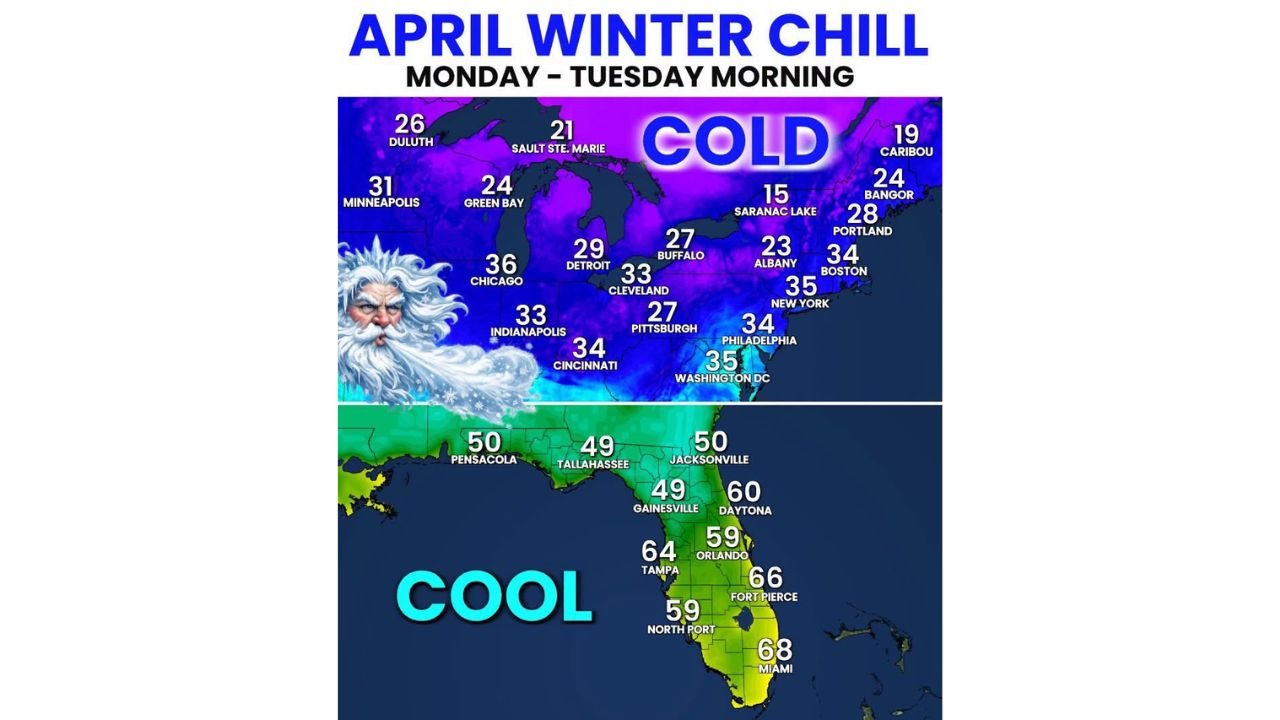
BUFFALO, New York — An April cold blast is sweeping across the Great Lakes and Northeast right now and the temperatures arriving Monday into Tuesday morning are not subtle. Freezing conditions are expected across a wide corridor from Duluth and Minneapolis through Detroit, Cleveland, Buffalo, Pittsburgh, and all the way to Albany and Boston — with some of the coldest readings of the entire spring season dropping into the teens and 20s across portions of the Northeast and Upper Midwest.
This is a genuine April winter chill — the kind of cold snap that arrives after weeks of warmth and catches residents, gardeners, and outdoor businesses completely off guard. The temperature map for Monday through Tuesday morning shows a stark divide across the Eastern United States — freezing purple and blue covering everything from the Great Lakes through New England, and a much more tolerable cool green zone across Florida where temperatures drop to the 40s and 50s but avoid a hard freeze.
Every City and Its Monday Low Temperature
Upper Midwest and Great Lakes — Freeze Territory:
- Duluth, Minnesota — 26 degrees — well below freezing, hard freeze conditions
- Minneapolis, Minnesota — 31 degrees — freezing temperatures for the metro area
- Sault Ste. Marie — 21 degrees — one of the coldest readings in the entire corridor
- Green Bay, Wisconsin — 24 degrees — hard freeze for a city still assessing damage from last week’s EF3 tornado outbreak
- Chicago, Illinois — 36 degrees — above freezing but bitterly cold for mid-April
- Detroit, Michigan — 29 degrees — below freezing overnight Monday
- Indianapolis, Indiana — 33 degrees — near freezing for the capital city
- Cincinnati, Ohio — 34 degrees — just above freezing with frost possible on exposed surfaces
- Cleveland, Ohio — 33 degrees — near-freezing conditions for northern Ohio
Northeast — Hard Freeze Zone:
- Saranac Lake, New York — 15 degrees — the coldest reading on the entire map, dangerous cold for mid-April in the Adirondacks
- Caribou, Maine — 19 degrees — extreme cold for the northern Maine communities
- Buffalo, New York — 27 degrees — below freezing with frost and freeze impacts across western New York
- Albany, New York — 23 degrees — hard freeze conditions for the capital region
- Bangor, Maine — 24 degrees — well below freezing across central Maine
- Portland, Maine — 28 degrees — near-freezing for the Maine coast
- Pittsburgh, Pennsylvania — 27 degrees — below freezing for the Steel City and surrounding communities
- Philadelphia, Pennsylvania — 34 degrees — just above freezing with frost possible on grass and elevated surfaces
- New York City — 35 degrees — above freezing but the coldest night of the spring season so far for the metro area
- Washington D.C. — 35 degrees — near-freezing for the capital, consistent with the frost concerns flagged earlier this week
- Boston, Massachusetts — 34 degrees — near-freezing for the New England metro
Florida — Cool But Not Freezing:
- Pensacola — 50 degrees — noticeably cool for the Panhandle but no freeze concern
- Tallahassee — 49 degrees — the coolest reading in Florida with no freeze expected
- Jacksonville — 50 degrees — cool but comfortable compared to what the Northeast is dealing with
- Gainesville — 49 degrees — lowest Florida inland reading Monday night
- Orlando — 59 degrees — pleasant cool overnight for Central Florida
- Tampa — 64 degrees — warm enough for comfortable sleeping with windows open
- Miami — 68 degrees — barely feels different from a typical mild night
Why April Freezes Are So Dangerous
A January freeze is expected and prepared for. An April freeze arriving after weeks of warmth catches everything off guard — plants, pipes, and people alike.
Gardens across the Great Lakes and Northeast are particularly vulnerable right now. The warm April temperatures that preceded this cold blast encouraged early planting across communities from Chicago to Boston. Tomatoes, peppers, basil, impatiens, and other warm-season plants that went into the ground during the recent heat are now facing temperatures that will kill them outright — 15 to 27 degrees is not a close call, it is a plant-destroying hard freeze.
Fruit trees across Michigan, New York, Pennsylvania, and New England that have already leafed out and in some cases begun flowering are facing potential crop damage from tonight’s freeze. Apple, cherry, and peach orchards that blossomed during the warm stretch are now at serious risk of frost damage to the developing buds — a single hard freeze at this stage of development can devastate an entire season’s crop.
Water pipes in older homes and buildings with inadequate insulation are also at risk in the coldest zones — 15 to 21 degree temperatures in Saranac Lake, Caribou, and Sault Ste. Marie are cold enough to freeze exposed or poorly insulated pipes overnight.
The Great Lakes Still Recovering From April 17
Green Bay at 24 degrees and Detroit at 29 degrees — these are communities still dealing with the aftermath of the April 17 outbreak that produced EF3 tornadoes in Wisconsin and tornado warnings across Indiana and Michigan. Homes with damaged roofs, broken windows, and compromised structures from last week’s severe weather are now facing near-freezing temperatures — a secondary weather hardship arriving on top of an active recovery effort.
Any Wisconsin or Indiana home with roof damage from the April 17 outbreak that has not yet been tarped or temporarily repaired faces the additional risk of overnight temperatures driving cold and moisture into already-damaged structures tonight and tomorrow morning.
Florida’s April Chill — Uncomfortable But Safe
Florida gets the cool but manageable end of this cold blast. Tallahassee at 49, Jacksonville at 50, and Gainesville at 49 are the coldest readings — uncomfortable for a state accustomed to warm nights but well above the freezing threshold that would trigger agricultural or infrastructure concerns.
Central and South Florida — Orlando at 59, Tampa at 64, Fort Pierce at 66, Miami at 68 — barely register as a cold event at all. These are pleasant sleeping temperatures for most residents and represent nothing more than a mild cool snap compared to what the Great Lakes and Northeast are enduring simultaneously.
What Residents Must Do Before Tonight
- Cover or bring in every warm-season plant — communities from Chicago to Boston need to protect any outdoor plants before temperatures drop tonight — this is not optional for anything you want to survive
- Fruit orchard operators in Michigan, New York, and Pennsylvania — monitor overnight temperatures closely and implement frost protection measures for any blossomed trees tonight
- Check on older homes with uninsulated pipes — 15 to 27 degree temperatures in the coldest zones are sufficient to freeze exposed plumbing overnight
- Wisconsin and Indiana homes with April 17 storm damage — ensure any damaged roof or window openings are covered before temperatures drop tonight
- Northeast gardeners — Albany at 23, Buffalo at 27, Pittsburgh at 27 — everything in the ground is at serious risk tonight, act before sunset
- Outdoor workers and events — Monday is a day for layers, wind protection, and limited outdoor exposure across the entire Great Lakes and Northeast corridor
The April winter chill arriving tonight is one of the sharpest cold snaps the Eastern United States has seen this spring. It will not last long — but the damage it causes to unprotected plants and vulnerable structures can be permanent.
WaldronNews.com will continue tracking this cold blast across the Great Lakes and Northeast and provide updates as temperatures drop Monday night and the situation develops through Tuesday morning.