
Virginia, Maryland, Delaware, New Jersey, New York and Massachusetts Brace as Explosive Atlantic Winter Storm Unleashes Extreme Thundersnow, Tornadic Waterspouts and 90 MPH Sting Jet Winds Offshore
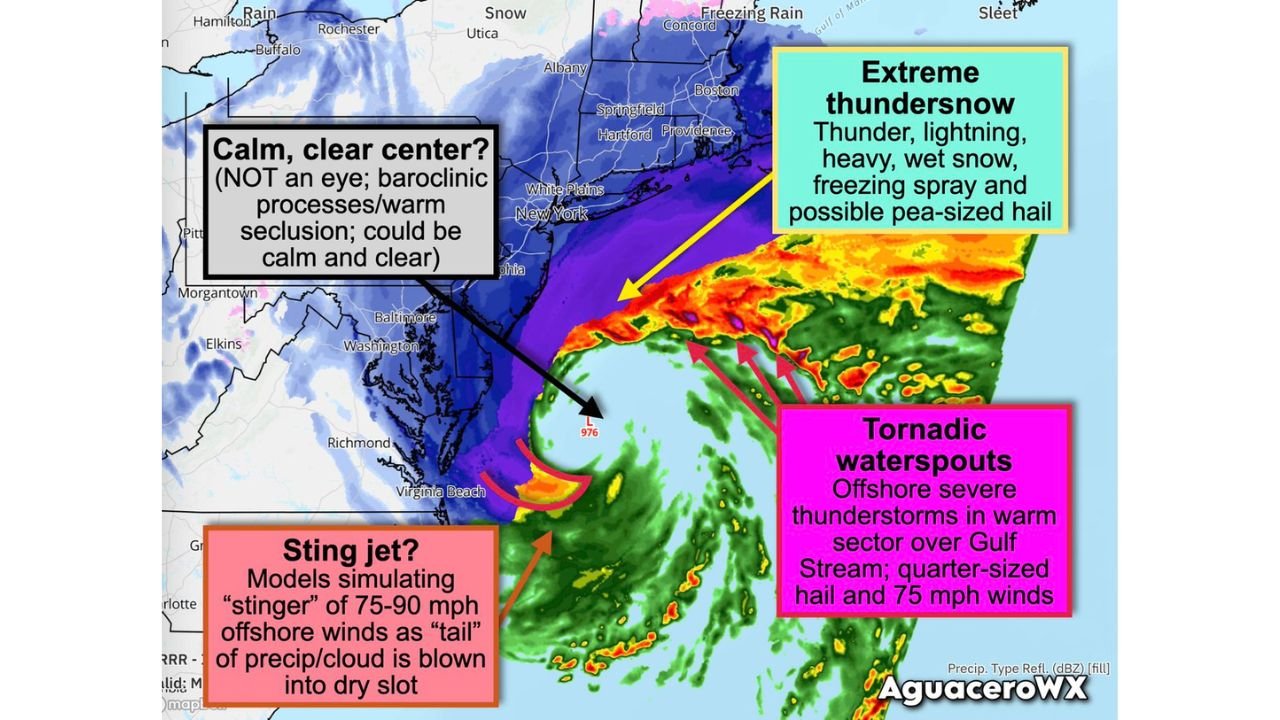
UNITED STATES — A rapidly intensifying Atlantic winter storm is exploding in strength just offshore of Virginia, Maryland, and Delaware, evolving into a powerful multi-hazard system capable of producing extreme thundersnow, tornado-strength waterspouts, and potentially destructive 75–90 mph “sting jet” winds over the open waters east of the Mid-Atlantic and southern New England.
Forecast modeling shows the low-pressure center consolidating east of Virginia Beach, Virginia, and the Delmarva Peninsula, deepening to around 976 mb as it tracks north-northeast offshore of New Jersey, New York, Connecticut, Rhode Island, and Massachusetts.
Meteorologists are calling it one of the most structurally impressive winter cyclones of the season.
A Calm, Clear Center May Form Offshore of Virginia and Maryland — But It’s Not a Hurricane
One of the most striking features of this storm is the potential development of a calm, clear center east of Virginia and Maryland.
While it may resemble a hurricane eye on satellite imagery, experts emphasize this is not tropical in nature. Instead, it forms through baroclinic processes and a phenomenon known as a warm seclusion, where relatively warmer air becomes wrapped into the core of the storm.
If this feature fully develops, it could create an eerie, almost symmetrical clearing surrounded by intense bands of snow and thunderstorms — a rare and dramatic sight over the Atlantic.
Extreme Thundersnow Targeting Waters East of New Jersey, New York and Massachusetts
On the northwest flank of the storm — just west of the rain/snow line — snowfall rates may exceed 3 inches per hour over the open Atlantic east of:
- New Jersey
- New York (including offshore of Long Island)
- Connecticut
- Rhode Island
- Massachusetts
These intense snow bands could produce thundersnow, a rare winter phenomenon where thunder and lightning occur within heavy snowfall.
Forecasters are also highlighting:
- Heavy, wet snow
- Lightning strikes over the ocean
- Freezing spray
- Possible pea-sized hail
Mariners operating east of southern New England could face whiteout conditions combined with lightning and strong winds — a dangerous combination rarely seen at this scale.
Tornadic Waterspouts Possible in Warm Sector East of Delaware and New Jersey
Meanwhile, in the storm’s warm sector over the Gulf Stream, severe thunderstorms may develop roughly 250 miles offshore of Delaware and New Jersey.
These storms could produce:
- Tornado-strength waterspouts
- Quarter-sized hail
- Wind gusts up to 75 mph
- Rotating thunderstorm cells embedded within the broader circulation
Although the strongest activity is projected to remain offshore, vessels traveling through Atlantic shipping lanes east of the Mid-Atlantic could encounter highly volatile conditions.
75–90 MPH “Sting Jet” Threat East of the Delmarva Peninsula
Perhaps the most concerning feature is the potential formation of a sting jet east of the Delmarva Peninsula (Maryland and Delaware coastline).
A sting jet occurs when wraparound precipitation is pulled into the storm’s dry slot, causing rapid evaporation and cooling. This leads to sinking air that drags powerful upper-level winds down to the surface.
Model simulations suggest a narrow corridor of winds reaching 75 to 90 mph over the Atlantic waters east of:
- Maryland
- Delaware
- Coastal New Jersey
If realized, these gusts would approach hurricane-force intensity — though confined primarily to offshore waters.
A Rare Multi-Hazard Winter System
What makes this storm extraordinary is the combination of extreme elements occurring simultaneously off the coasts of Virginia, Maryland, Delaware, New Jersey, New York, Connecticut, Rhode Island, and Massachusetts:
- Blizzard-level snowfall rates over open waters
- Lightning-producing thundersnow
- Tornadic waterspouts in the warm sector
- A possible hurricane-like calm center
- A powerful sting jet capable of 90 mph winds
Forecasters have described the system as a “meteorological masterpiece” due to its structural complexity and explosive intensification.
Coastal Impacts Still Possible
While the most extreme conditions are expected to remain offshore, coastal communities from Virginia Beach, Virginia, to Cape May, New Jersey, and north toward Long Island, New York, and southern Massachusetts could still experience:
- Strong coastal wind gusts
- Periods of heavy precipitation
- Rough surf and hazardous marine conditions
Small track shifts could alter the extent of impacts along the coastline.
WaldronNews.com will continue monitoring this rapidly evolving Atlantic winter storm as it intensifies east of the Mid-Atlantic and southern New England. Mariners and coastal residents are urged to stay alert as this rare and powerful system unfolds offshore.