
Wisconsin EF3 Tornadoes Confirmed as April 17 Outbreak Final Count Reaches 150 Warnings and 40 Tornadoes Across Iowa Illinois and Indiana
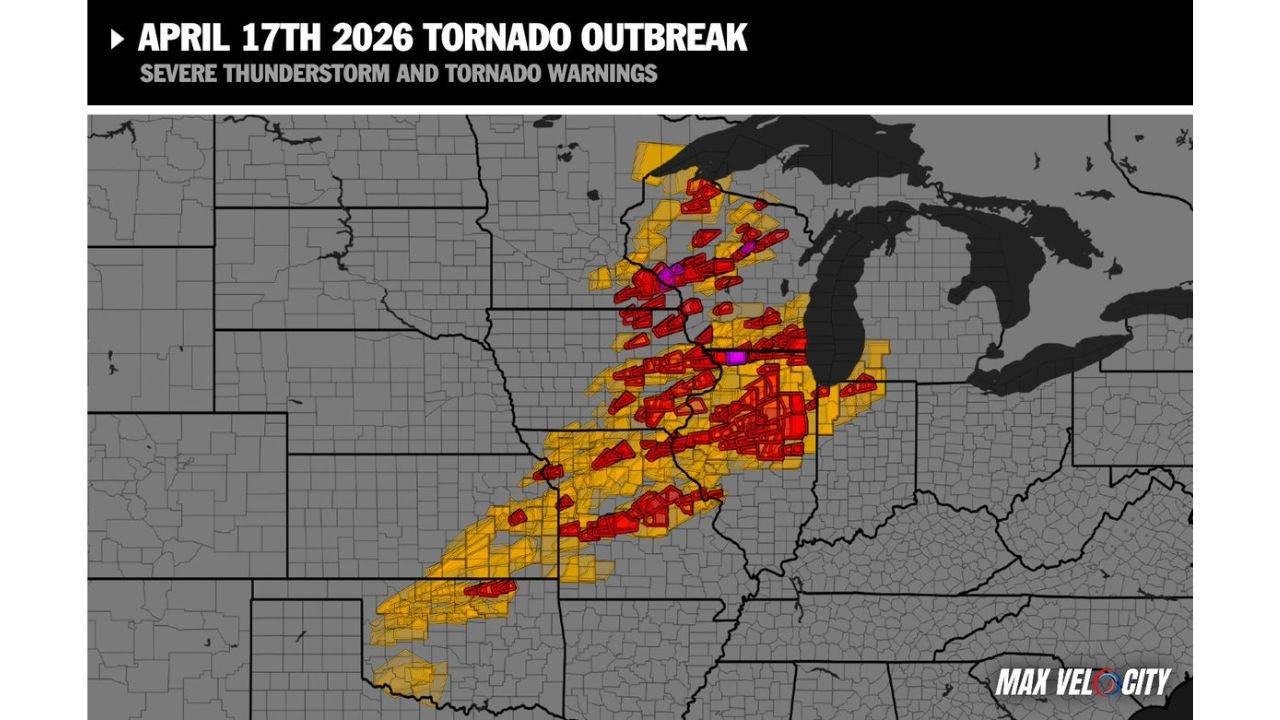
MADISON, Wisconsin — Official damage surveys are now confirming what radar and storm reports suggested Friday — the April 17, 2026 tornado outbreak is one of the most significant single-day severe weather events the Upper Midwest has seen in years. The final count stands at 150 tornado warnings, at least 40 confirmed tornadoes, and two EF3 tornadoes now officially confirmed in Wisconsin — making today’s confirmation numbers a sobering reminder of just how violent Friday’s atmosphere truly was.
The warning map covering the full outbreak footprint tells the complete story. A massive corridor of red tornado warning polygons stretches from Iowa and Minnesota in the northwest all the way through Illinois, Indiana, and into the Great Lakes — a continuous outbreak corridor spanning hundreds of miles across six states lasting from early Friday afternoon through the overnight hours into Saturday morning.
The Full Six-State Outbreak Footprint
- Wisconsin: Two officially confirmed EF3 tornadoes — the most violent storms of the entire outbreak — damage survey teams confirming tracks through southwestern Wisconsin communities
- Iowa: Outbreak initiation zone where the first supercells fired Friday afternoon with STP values reaching 4.3 near Mason City — some of the most extreme tornado parameter values recorded this spring
- Illinois: Longest continuous red tornado warning corridor on the map — Rockford south through Bloomington, Decatur, Pontiac, and Lincoln — where the QLCS embedded tornado phase produced widespread destruction
- Indiana: Tornado warnings through South Bend, Elkhart, Mishawaka, and Osceola in the overnight hours covering 373,600 residents simultaneously at 1 AM Saturday
- Minnesota: Northern edge of the outbreak with severe thunderstorm warnings across southern counties
- Michigan: Trailing edge of the system pushing into the Great Lakes region through Saturday morning
What Two Confirmed EF3 Tornadoes Mean for Wisconsin
An EF3 tornado requires wind speeds of 136 to 165 mph to achieve that rating. Two confirmed from a single outbreak day in Wisconsin speaks directly to how extreme Friday’s atmospheric setup was.
The CAPE values exceeding 5,000 J/kg, 80+ knot bulk shear, and STP values of 4.3 near Mason City all translated directly into violent long-track supercells capable of EF3 intensity across southwestern Wisconsin.
EF3 damage means well-constructed homes with foundations have entire walls collapsed. Vehicles are thrown significant distances. Large trees are completely debarked. Communities in the path of Friday’s confirmed EF3 tracks in Wisconsin are facing weeks if not months of recovery ahead.
The 150 Warning and 40 Tornado Numbers in Context
150 tornado warnings in a single outbreak is extraordinary. A typical active severe weather day produces 20 to 40 warnings across an affected region. 150 means meteorologists were issuing warnings continuously across six states from Friday afternoon through Saturday early morning — an unrelenting 12-hour severe weather emergency.
The 40 confirmed tornado figure will grow. Damage survey teams are still working across Iowa, Wisconsin, Illinois, and Indiana — many QLCS tornadoes from Friday’s Illinois squall line phase have not yet been ground-surveyed and documented. The final tornado count from April 17 is expected to climb significantly above 40 in the coming days.
What Affected Communities Should Do Right Now
- Wisconsin EF3 track communities — do not enter damaged structures until local authorities have completed structural inspections — EF3 wind damage can leave buildings appearing standing but critically unsafe inside
- Iowa, Illinois, and Indiana residents — document all property damage immediately with photographs and video before any cleanup begins — essential for insurance claims
- Report damage to county emergency management — ground survey teams need community reports to locate and fully document all tornado tracks from Friday
- Assume all downed power lines are live — stay well clear of any downed lines across the outbreak corridor
- Begin monitoring Thursday April 23 — a 15% tornado probability is already posted for Kansas and Oklahoma later this week — the severe weather season is not pausing for recovery
April 17, 2026 is now officially one of the most significant tornado outbreak days in Upper Midwest history. Recovery across Wisconsin, Iowa, Illinois, and Indiana is just beginning.
WaldronNews.com will continue tracking confirmed tornado counts, EF ratings, and damage reports from the April 17 outbreak as survey teams report in from across all affected states.